Ireland’s event industry is at a turning point. From global festivals and conferences to regional cultural gatherings, events drive creativity, tourism, innovation, and employment. Yet the absence of a unified national framework means the sector continues to operate within fragmented regulation, inconsistent permitting, and under-resourced workforce pipelines. To secure sustainable growth and international competitiveness, Ireland needs a National Event Strategy, underpinned by a new coordinating body: the National Event Safety and Advisory Group (NESAG).
The Context: A High-Value but Under-Governed Sector
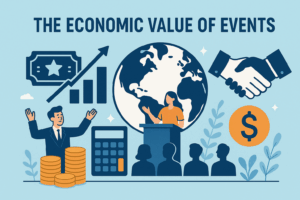
Ireland’s event ecosystem spans tourism, culture, business, education and public services. It contributes billions annually to the national economy, supporting more than 330,000 jobs across the broader experience economy (IBEC, 2024). The Business Events 2030 strategy identifies business events alone as generating over €1 billion annually and sustaining approximately 22,000 jobs (Department of Enterprise, 2025).
Despite this impact, there is no single policy framework guiding event regulation, safety, sustainability, or digital transformation. Regulation remains scattered across the Planning and Development Acts 2000–2025, Licensing of Indoor Events Act 2003, Public Dance Halls Act 1935, and diverse local-authority practices. The result: inefficiencies, duplication, and uneven application of standards across jurisdictions.
Why a National Strategy, and NESAG, Are Essential
-
Fragmented oversight
Multiple agencies operate independently, planning authorities, Garda Síochána, HSE, Fire Services, Fáilte Ireland and cultural departments, with no shared accountability mechanism. -
Rising complexity and risk
Large-scale, hybrid and outdoor events are increasing in scale and sophistication, demanding consistent, expert oversight of safety, logistics, and regulatory compliance. -
Workforce and accreditation challenges
Skills shortages and the absence of a national accreditation model weaken Ireland’s capacity to deliver safe, high-quality events. -
International competitiveness
Peer destinations, such as the Netherlands and Denmark, have national events frameworks linking safety, innovation, and economic policy. Ireland’s lack of a cohesive model constrains its ability to attract major events. (UNWTO, 2024) -
Policy alignment
A coordinated strategy would unify event regulation with national agendas on digital transformation, sustainability, night-time economy, and regional development.
Introducing NESAG: A Framework for Coordination and Excellence
The National Event Safety and Advisory Group (NESAG) should be established as the operational cornerstone of Ireland’s event strategy. Operating under the joint aegis of the Department of Enterprise, Trade and Employment and the Department of Tourism, Culture, Arts, Gaeltacht, Sport and Media, NESAG would provide a single forum for national coordination, guidance, and continuous improvement.
NESAG’s Core Functions:
-
National Standards and Guidance: Develop and maintain unified event-management, safety, and sustainability standards for use across all local authorities.
-
Digital Permitting Oversight: Lead the design and governance of a national Single Event Permit Portal, integrating planning, licensing, and statutory submissions.
-
Safety and Risk Governance: Coordinate inter-agency risk assessment, emergency planning, and post-event review frameworks.
-
Accreditation and Workforce Development: Partner with EIAI, Fáilte Ireland, SOLAS and academic institutions to embed professional accreditation and continuous-learning standards.
-
Research and Data Analytics: Publish annual industry reports capturing economic impact, workforce metrics, and incident trends to inform national policy.
-
Stakeholder Collaboration: Convene local authorities, event organisers, statutory agencies, and community representatives in structured consultation and review processes.
-
Advisory Role to Government: Provide policy recommendations, legislative review input, and guidance on emerging risks and technologies.
NESAG’s formation would give Ireland a standing, expert body capable of turning fragmented practice into a national system of excellence.
Core Pillars of the National Event Strategy
-
Governance and Coordination
-
Formalise NESAG as the central coordination and advisory mechanism.
-
Assign NESAG authority to issue national guidance and oversee inter-agency collaboration.
-
-
Modern Regulation and Standards
-
Consolidate outdated laws under a new Events and Safety Act.
-
Embed NESAG guidance as the national benchmark for event safety, sustainability, and accessibility.
-
-
Digital Transformation
-
Deploy the Single Event Permit Portal under NESAG governance, enabling one-stop submissions and transparent tracking.
-
Use data analytics for continuous improvement and evidence-based policymaking.
-
-
Workforce and Accreditation
-
Introduce a tiered national accreditation system aligned to EIAI professional standards.
-
NESAG to coordinate training frameworks, ensuring alignment between regulators, education, and industry.
-
-
Sustainability and Social Impact
-
Set national sustainability targets for events (carbon reduction, waste management, inclusion).
-
Support NESAG’s publication of annual sustainability performance indicators.
-
-
Funding and Investment
-
Establish a National Event Innovation & Safety Fund, administered jointly by NESAG and government, to support research, training, and technology upgrades.
-
-
Measurement and Accountability
-
Require NESAG to produce an Annual State of the Event Industry Report detailing performance, compliance trends, and policy outcomes.
-
Expected Benefits
-
Consistency — One set of national standards across all jurisdictions.
-
Transparency — Digital permitting and public reporting build trust.
-
Efficiency — Streamlined processes reduce delays and costs.
-
Professionalisation — Accreditation and workforce pathways raise quality.
-
Safety and Sustainability — Shared frameworks enhance compliance and resilience.
-
Economic Value — Predictable governance encourages investment and international growth.
The Role of EIAI
The Event Industry Association of Ireland (EIAI) should act as NESAG’s key industry partner — representing members’ expertise, coordinating professional accreditation, and feeding real-world data into policy. Through structured collaboration with NESAG, EIAI can ensure that the industry’s voice directly shapes national standards, workforce programmes and legislative reform.
Conclusion
Ireland’s event industry has demonstrated creativity, resilience, and global ambition. What it now needs is structural coherence. The establishment of a National Event Safety and Advisory Group (NESAG), embedded within a formal National Event Strategy, will transform Ireland’s approach from reactive regulation to proactive, data-driven governance. This unified framework will safeguard public safety, professionalise practice, stimulate regional economies and elevate Ireland as a global benchmark for excellence in event management.
The time for fragmented processes has passed — the future of Ireland’s events must be coordinated, collaborative and strategically led.
Please click here to view our Event Industry Recovery Plan sumamry document (or request a full copy), originally submitted by EIAI to the Department of Tourism, Culture, Arts, Gaeltacht, Sport and Media in 2021. This document captured the sector’s immediate response priorities during the pandemic and proposed structural reforms that remain highly relevant today — including the creation of a unified governance model, enhanced workforce accreditation, and the integration of digital permitting systems. Many of these recommendations form the foundation of our current “Road to Recovery” strategy, demonstrating clear continuity between the lessons learned during COVID-19 and the long-term need for a National Event Safety & Advisory Group (NESAG) and a coordinated National Event Strategy. Together, these documents reflect the sector’s sustained commitment to building a more resilient, professional, and future-ready events ecosystem for Ireland.
References
Department of Enterprise, Trade and Employment (2025) Business Events 2030. Dublin: Government of Ireland. Available at: https://enterprise.gov.ie/en/publications/publication-files/business-events-2030.pdf
Department of Housing, Local Government and Heritage (2025) Planning and Development (Licensing of Outdoor Events) Regulations 2025. Dublin: Government of Ireland. Available at: https://www.opr.ie/wp-content/uploads/2025/02/Planning-and-Development-Licensing-of-Outdoor-Events-%E2%80%93-PDA-2000-Regulations-2025-S.I.-No.-37-of-2025.pdf
Department of Tourism, Culture, Arts, Gaeltacht, Sport and Media (2023) Report of the Night-Time Economy Taskforce. Dublin: Government of Ireland. Available at: https://www.gov.ie/en/publication/4f021-report-of-the-night-time-economy-taskforce/
Fáilte Ireland (2025) Tourism Careers and Labour Market Research 2025. Dublin: Fáilte Ireland. Available at: https://www.failteireland.ie/
IBEC (2024) Experience Economy Insights Report. Dublin: IBEC. Available at: https://www.ibec.ie/influencing-for-business/ibec-campaigns/experience-economy/experience-economy-insights-report
UNWTO (2024) Global Conference on Sustainable and Competitive Events: Policy Brief. Madrid: UNWTO. Available at: https://www.unwto.org/