The live events experience begins long before an audience member arrives at a venue, festival site or arena. It begins at the point of discovery, promotion and ticket purchase. That is why the current debate around dynamic ticket pricing matters so much for Ireland’s events industry.
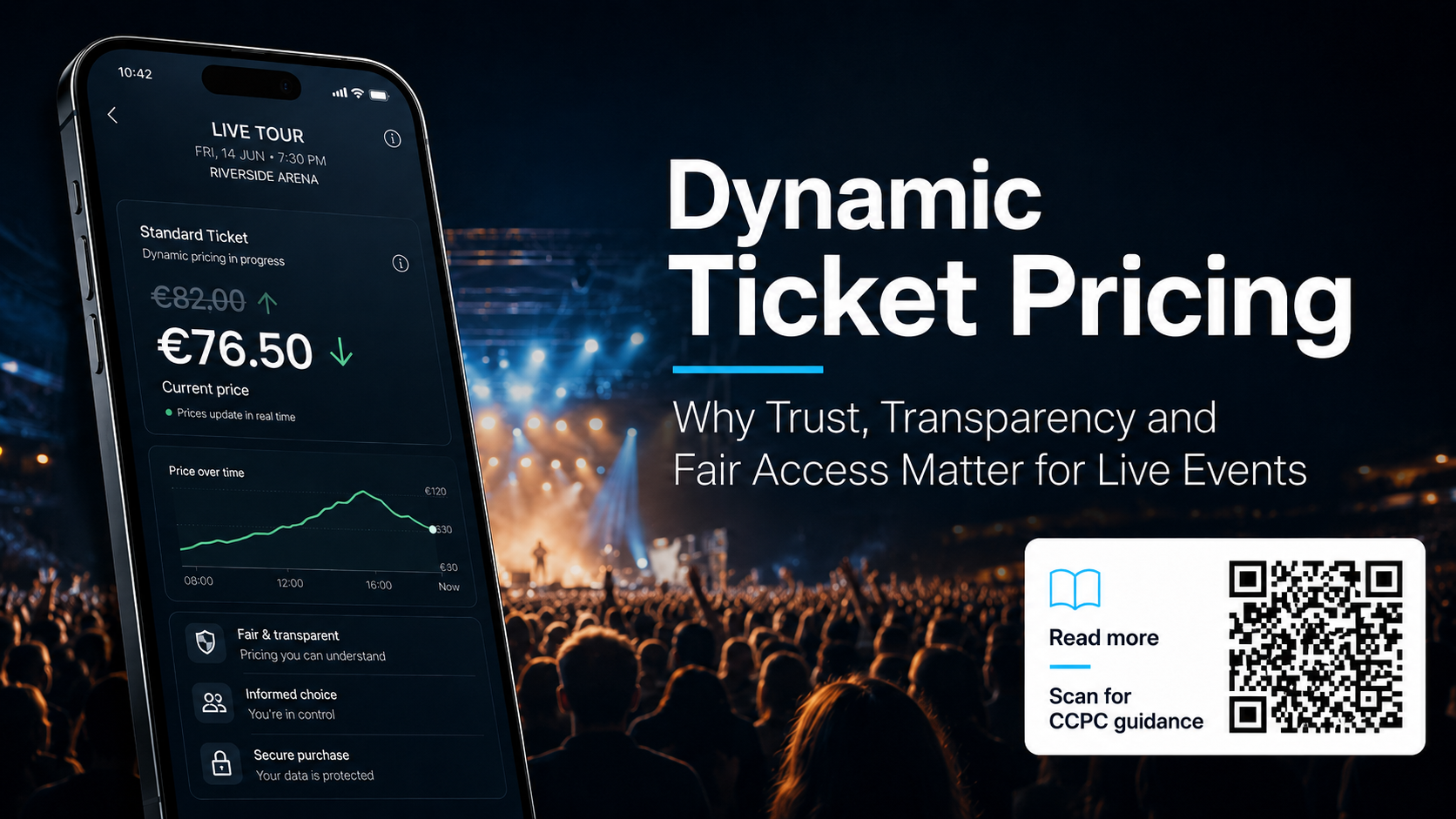
Dynamic pricing, where ticket prices can change in response to demand, is not, in itself, automatically unlawful in Ireland. The Competition and Consumer Protection Commission notes that dynamic pricing is not currently defined under Irish or EU consumer protection legislation and is not prohibited in most cases. However, the CCPC also makes clear that pricing practices may become problematic where they are misleading, unfair, or place undue pressure on consumers.
For the events industry, this is not only a legal or consumer-rights issue. It is a trust issue.
Consumer trust is part of the event experience
Audiences understand that events cost money to produce. They understand that artists, venues, suppliers, production teams, security, medical cover, insurance, licensing, infrastructure and compliance all carry real costs. However, what audiences increasingly find difficult to accept is uncertainty at the point of purchase. When a consumer joins an online queue expecting one price and reaches checkout to find a substantially higher price, the damage is not limited to that individual transaction. It can weaken confidence in the wider live events marketplace.
This matters because live events depend on public goodwill. Whether it is a concert, festival, cultural event, comedy show, sporting fixture, community event or theatre performance, people need to feel that the process is fair, transparent and respectful. The public debate following high-profile concert sales has shown how quickly frustration can build when pricing appears unclear. In 2024, the CCPC opened an investigation into Ticketmaster following complaints from Oasis fans in Ireland, where consumers experienced long online queues and then encountered significantly increased prices linked to dynamic pricing.
The issue is not simply “high prices”
It is important to be clear: the issue is not simply that tickets are expensive. Events are expensive to deliver. Costs have increased across almost every part of the events industry, from staffing and production to insurance, security, infrastructure, transport, compliance and venue operations. Promoters and organisers must be able to build financially sustainable events. Without commercial viability, events do not happen. The real issue is whether the consumer has clear, accurate and timely information before making a purchasing decision.
If dynamic pricing is used, consumers should understand that prices may change. They should know whether the price they are seeing is fixed, limited, demand-based, time-limited, or subject to movement. They should not feel that they were drawn into a queue on one expectation and presented with a materially different reality at the point of checkout. Transparency should not be treated as a burden. It is a foundation of consumer confidence.
The EU debate is moving quickly
This issue is now firmly on the European policy agenda. Ireland’s European Commissioner for Justice, Michael McGrath, has been reported as leading work at EU level through the proposed Digital Fairness Act, with live event ticketing and dynamic pricing among the areas under scrutiny. Reported proposals include stronger requirements around transparency, clearer information on ticket availability and pricing tiers, and restrictions on vague “starting from” pricing where consumers are not given the full picture.
The CCPC has also supported stronger digital fairness rules at EU level. In its submission on the proposed Digital Fairness Act, the CCPC highlighted concerns around unfair and misleading online design techniques, including dark patterns, discriminatory personalised pricing, misleading digital practices and subscription traps. It also called for practical measures to improve consumer decision-making online, support enforcement and give clearer obligations to traders.
For the events industry, this signals that the direction of travel is clear: ticketing systems will face increasing expectations around fairness, transparency and accountability.
A fair system must work for audiences and organisers
EIAI believes the conversation must avoid simplistic blame. The live events ecosystem is complex. Ticketing platforms, promoters, venues, artists, managers, agents, sponsors, suppliers, regulators and public authorities all form part of the system. In many cases, pricing decisions are influenced by multiple commercial and contractual factors. Any future rules must therefore be practical, proportionate and workable.
Good regulation should protect audiences from misleading or unfair practices while also recognising the commercial pressures faced by event organisers and promoters. It should support fair access without making it impossible to finance ambitious live events, this balance matters.
If regulation focuses only on the consumer transaction but ignores the wider delivery reality, it risks missing the bigger picture. If the industry focuses only on revenue optimisation and ignores consumer trust, it risks damaging the very audience relationship on which live events depend.
What good practice could look like
The events industry should not wait for regulation before improving transparency. A stronger approach to ticketing could include:
- clear upfront notice where dynamic pricing may apply;
- plain-English explanations of how prices may change;
- visibility on ticket categories, price bands and availability where possible;
- avoidance of misleading “from” pricing where only a very limited number of tickets are available at that price;
- clear display of fees, charges and final checkout price;
- fair queueing systems that do not create unnecessary pressure;
- refund, transfer and resale rules that are easy for consumers to understand;
- accessibility ticketing processes that are not made harder by high-pressure sales systems.
These measures are not anti-business, they are pro-confidence. The stronger the trust between audiences and event providers, the healthier the long-term market becomes.
Why this matters to Ireland’s events industry
Ireland’s events industry has enormous cultural, social and economic value. It supports artists, venues, suppliers, production professionals, local businesses, tourism, hospitality and communities across the country – that value depends on public participation.
When people feel priced out, misled or pressured, the relationship between audiences and live events is weakened. When people feel informed, respected and treated fairly, they are more likely to return, recommend, participate and support the industry over time.
Dynamic ticket pricing may remain part of some commercial models, but it must be handled with care. The future of ticketing should not be based only on what a consumer might be willing to pay in a high-pressure moment. It should also consider what is fair, transparent and sustainable for the long-term health of the events industry.
EIAI’s position
EIAI supports a live events environment that is commercially viable, professionally delivered and trusted by the public. As the debate on dynamic pricing and digital fairness continues, Ireland has an opportunity to lead with a balanced approach: one that protects consumers, gives clarity to businesses, supports fair access, and recognises the real costs and responsibilities involved in delivering live events.
For consumer guidance on dynamic pricing, readers can visit the Competition and Consumer Protection Commission’s information page here: CCPC guidance on dynamic pricing