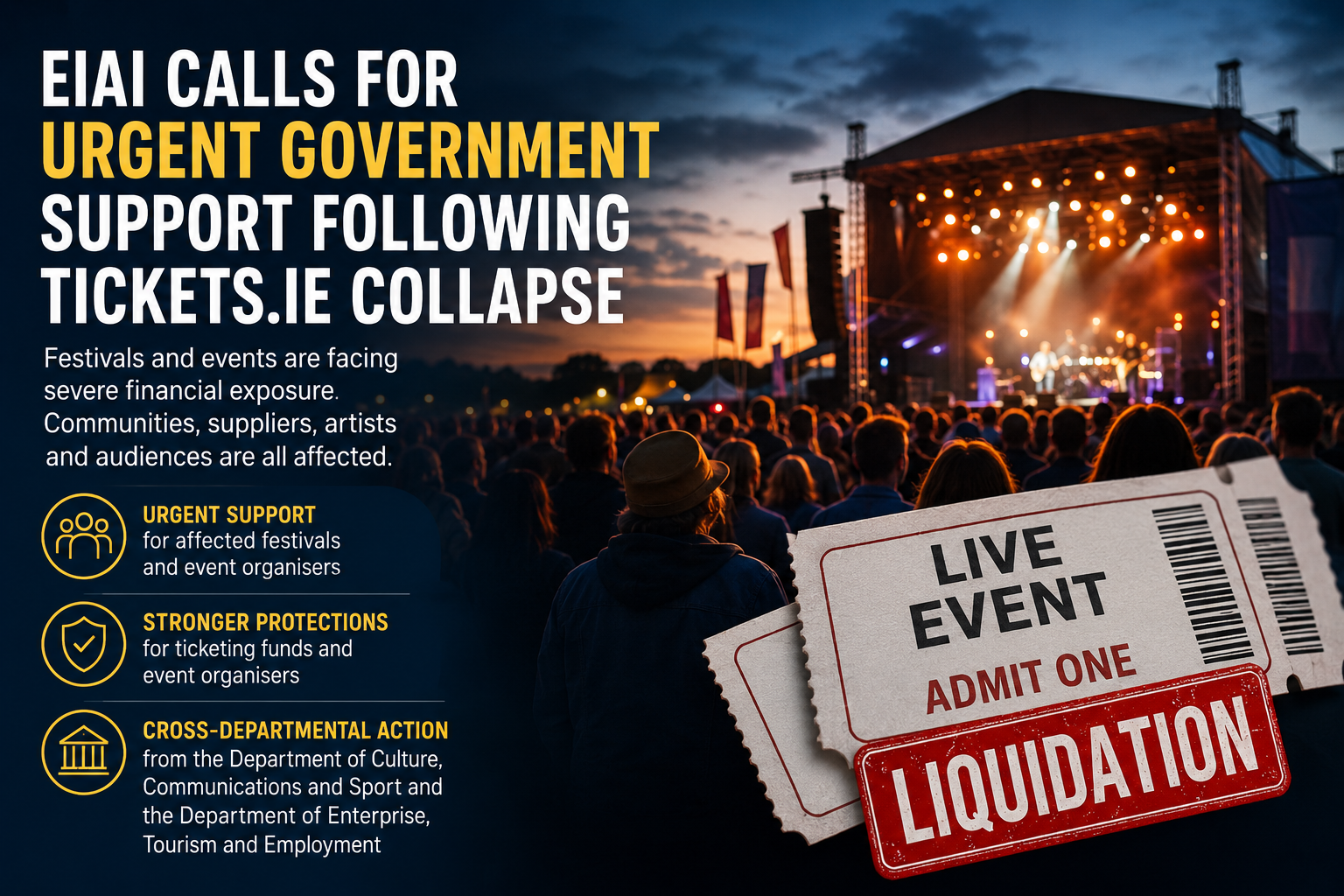
The collapse of Tickets.ie has exposed a serious vulnerability in Ireland’s events industry. Tickets.ie, operated by Oshi Software Limited, has ceased trading, with the company stating that its directors are taking steps to place it into liquidation and appoint a liquidator. Customers with tickets for upcoming events have been advised to await direct communication from the relevant event promoter.
For affected organisers, however, the issue is far more immediate. Across Ireland, festivals and events are now facing serious financial exposure following the sudden collapse of one of the country’s best-known ticketing providers. Reports indicate that some events are facing losses running into hundreds of thousands of euro, with Cowboys and Heroes, the Rory Gallagher International Tribute Festival and Rockathon among those publicly identified as affected.
This is not simply a private commercial dispute, it is a cultural issue, an enterprise issue, a tourism issue and a regional economy issue.
EIAI is calling on the Department of Culture, Communications and Sport and the Department of Enterprise, Tourism and Employment to work together urgently to support affected festivals and event organisers, particularly where otherwise viable events are at risk because ticket income collected through a third-party platform has not been transferred.
Ticket income is event delivery cashflow
For many people outside the industry, ticketing may seem like a straightforward transaction. A customer buys a ticket, receives confirmation and attends an event. For event organisers, ticketing income is much more than that. It is often the working cashflow that allows an event to be delivered. It supports payments to artists, venues, suppliers, production teams, security providers, medical providers, infrastructure contractors, insurance, licensing, traffic management, local services, crew and compliance costs.
Many festivals and events commit to these costs months before an audience arrives on site. The public sees the event weekend, the organiser carries the financial risk long before the gates open. When ticketing income is held by a third-party provider and is not transferred as expected, the consequences can be immediate and severe. Organisers may still be liable for the cost of delivering the event, even where the income generated from ticket sales has not reached them. That is the gap now exposed.
This affects communities, not only organisers
Festivals and events are not isolated commercial activities. They support local businesses, accommodation providers, hospitality, transport, artists, suppliers, freelance crew, volunteers, community organisations and local authorities. In many towns and rural areas, annual festivals are major economic and cultural anchors. When a festival is placed under financial pressure, the impact is felt well beyond the organising committee.
Hotels, pubs, restaurants, shops, taxi operators, production suppliers, food traders, local sponsors, tourism providers and community groups can all be affected. Audiences are also left uncertain, particularly where they have purchased tickets and are waiting for clarity about whether events will proceed. That is why government support must now be considered seriously and urgently.
If otherwise viable festivals are placed at risk because ticket income collected on their behalf has not been transferred, then the response should not be limited to sympathy. It should include practical consideration of emergency supports, continuity measures and future protections.
A coordinated Government response is needed
EIAI welcomes the fact that Minister for Enterprise, Tourism and Employment Peter Burke has indicated that his Department will examine what supports may be available. However, this issue should not sit with one Department alone. The Department of Culture, Communications and Sport has a clear role because many of the affected events are live music festivals, cultural gatherings and community-based events that contribute directly to Ireland’s creative life and public participation in culture.
The Department of Enterprise, Tourism and Employment also has a clear role because festivals and events support employment, tourism, local enterprise, hospitality, regional development and supply chains.
This issue sits directly across both policy areas.
For that reason, EIAI is calling for an urgent cross-departmental response involving both Departments, with a focus on:
- identifying affected festivals and event organisers;
- assessing the scale of financial exposure;
- protecting otherwise viable events where possible;
- supporting clear communication with ticket holders;
- examining whether emergency bridging support or targeted relief can be provided;
- beginning an immediate review of how event ticketing funds are protected in Ireland.
The immediate priority must be to prevent viable festivals and events from being lost because of a failure in the ticketing supply chain. The longer-term priority must be to ensure that this level of exposure is not allowed to happen again.
Ireland needs stronger protection for ticketing funds
The collapse of Tickets.ie raises an urgent policy question, should ticketing income collected on behalf of event organisers be treated as ordinary business revenue held by a ticketing company, or should it be protected because it is money collected for future or recently delivered events?
EIAI believes this question now requires proper examination.
Where a ticketing company holds significant sums connected to live events, there should be clear expectations around how those funds are protected, how often they are settled, what happens if the provider becomes insolvent, and what information is available to organisers.
A stronger framework could include consideration of:
- ring-fenced client accounts for ticketing income;
- clearer rules on settlement timelines;
- transparency obligations where ticketing providers hold organiser funds;
- regular reporting to event organisers on funds held;
- minimum financial safeguards for high-volume ticketing providers;
- clearer contract terms on fund ownership and insolvency risk;
- stronger due diligence guidance for event organisers choosing ticketing partners;
- clear consumer communication protocols where a ticketing provider ceases trading.
These issues should be examined in consultation with the events industry, ticketing providers, consumer bodies, insolvency experts, Government Departments and local authorities. Any future framework must be practical and proportionate. It must work for large promoters, independent festivals, arts organisations, community events, sports events, venues and voluntary committees. But the principle should be clear: money collected for events should be protected in a way that reflects the real-world risks carried by organisers, ticket buyers, suppliers and communities.
Ticketing is now part of event risk management
This situation also highlights the need for event organisers to treat ticketing arrangements as a core operational risk. Ticketing is no longer just an administrative or marketing function. It is a critical dependency in the event delivery chain. Organisers should now be asking:
- How often are ticket funds transferred?
- Are funds held in a separate client account?
- What happens if the ticketing provider becomes insolvent?
- Who legally owns the ticketing income before settlement?
- What information is available about funds held?
- Can sales be transferred quickly to another platform if needed?
- Who controls customer data and communication?
- What are the refund obligations?
- Are contract terms reviewed before sales open?
These questions are now as important as insurance, licensing, safety planning, supplier contracts and site infrastructure. The events industry has always managed risk. But this collapse shows that financial and platform risk must be treated as part of event resilience.
EIAI’s position
EIAI is calling on the Department of Culture, Communications and Sport and the Department of Enterprise, Tourism and Employment to provide urgent, coordinated support for festivals and events affected by the collapse of Tickets.ie. The immediate focus must be on affected organisers, affected communities, ticket holders and the continuity of viable events. But the longer-term response must address the regulatory and operational gap that has allowed organisers to be left so exposed. Ireland’s events industry is too important to be vulnerable to avoidable financial shocks.
Festivals and events support culture, tourism, employment, local economies, artists, suppliers, volunteers and community life. They deserve systems that recognise the scale of responsibility carried by organisers and the trust placed in ticketing providers by the public. This is not only about one company, it is about building a more resilient, transparent and accountable events industry for the future.
Read more
Tickets.ie company notice: https://eol.tickets.ie/
RTÉ: Independent ticketing company Tickets.ie ceases trading: https://www.rte.ie/news/2026/0603/1576580-tickets-ie-closes/
The Irish Times: Online ticket agent Tickets.ie faces liquidation after ceasing trading: https://www.irishtimes.com/business/2026/06/03/german-owned-online-agent-ticketsie-faces-liquidation-after-ceasing-trading/
Irish Examiner: Three Irish music festivals seek compensation following Tickets.ie collapse: https://www.irishexaminer.com/news/arid-41856951.html
The Currency: Rory Gallagher music festival hit by liquidation of Tickets.ie: https://thecurrency.news/articles/229428/rory-gallagher-music-festival-hit-by-liquidation-of-tickets-ie/