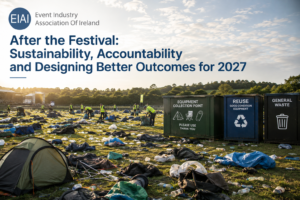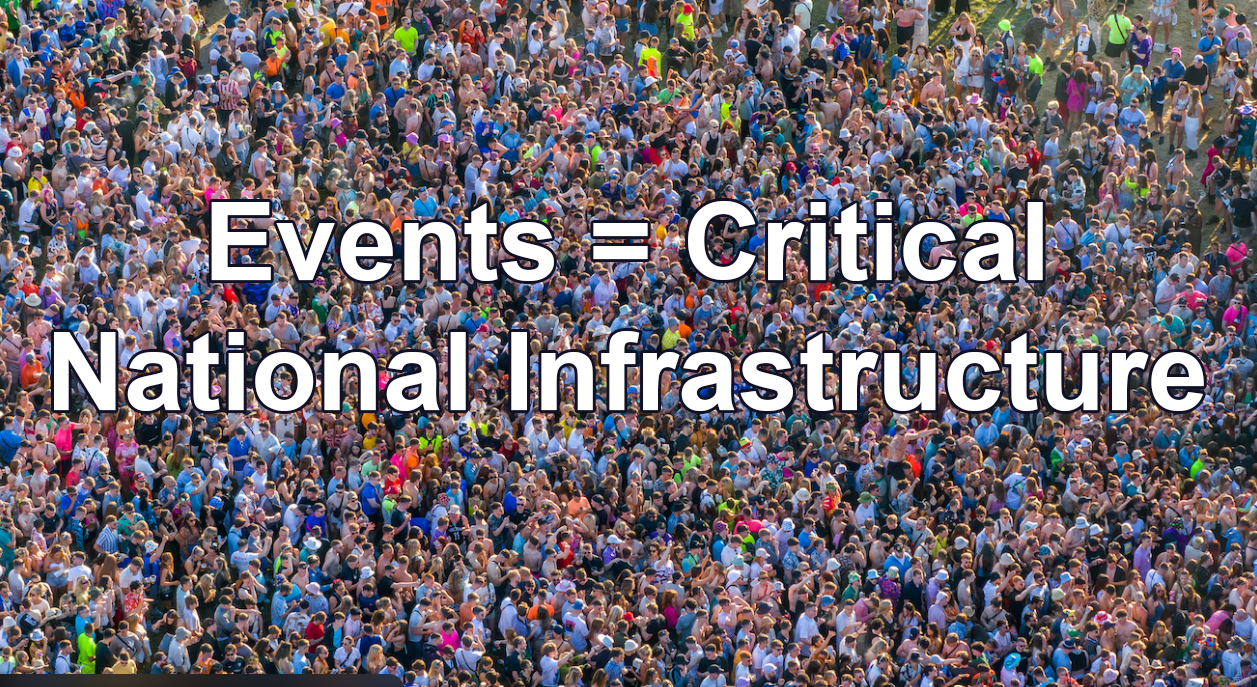
The recent launch of the €6.5 million Creative Climate Action Fund III signals an important shift in how Government views climate action. It recognises that climate change is not only a scientific or regulatory challenge, it is a cultural one, and culture is delivered, activated and experienced through the events industry.
Climate Action Requires Behaviour Change
Ireland is not currently on track to meet its climate targets. Policy, regulation and infrastructure investment are essential — but they are not sufficient on their own.
Climate transition requires:
- Behavioural change
- Community engagement
- Cultural shifts
- Public understanding
- Organisational transformation
These are not abstract concepts. They are the daily operating environment of the events industry. Every festival, concert, sporting fixture, conference and community gathering is a platform for collective experience and collective influence.
Events are where:
- Sustainable transport choices are shaped
- Food systems are modelled
- Waste behaviour is demonstrated
- Energy systems are tested
- Public attitudes are influenced at scale
That is infrastructure – not roads, not fibre, not energy grids. Social infrastructure. Behavioural infrastructure. Cultural infrastructure.
The Events Industry as a Climate Delivery Platform
The events industry delivers:
- National and regional festivals
- Cultural and live music programming
- Major international conferences
- Community-led gatherings
- Touring productions
- Cross-border initiatives
These platforms reach millions of citizens annually. If climate engagement is to move beyond awareness into adoption, the events industry is uniquely positioned to:
- Translate climate science into lived experience
- Model sustainable practice at scale
- Test circular economy systems in real time
- Influence supply chains
- Shift audience behaviour through participation
This is not theoretical, it is already happening across Ireland — but without being strategically recognised as climate infrastructure.
From Compliance to Leadership
Historically, sustainability within the events industry has often been framed as compliance:
- Waste reduction
- Licensing conditions
- Environmental checklists
That model is outdated, the next phase must be:
- Design-led sustainability
- Behavioural impact measurement
- Data-driven engagement
- Cross-agency collaboration
- Climate literacy embedded in programming
The Creative Climate Action Fund recognises that creative engagement can drive measurable change. The events industry is the delivery mechanism capable of scaling that ambition.
A Just Transition Requires Public Platforms
The national climate agenda includes:
- Just transition
- Renewable energy expansion
- Sustainable transport
- Circular economy
- Biodiversity restoration
None of these objectives succeed without public understanding and buy-in. Events create trusted civic spaces where:
- Difficult conversations can happen
- Local impact can be contextualised
- Innovation can be demonstrated
- Community voices can be heard
If we are serious about a just transition, we must recognise that climate infrastructure includes cultural infrastructure. And cultural infrastructure includes the events industry.
What Recognition Should Look Like
Recognising the events industry as critical climate infrastructure means:
- Integrating events into national climate engagement strategies
- Including the events industry in climate policy consultation
- Supporting innovation in sustainable event production
- Enabling cross-border climate collaboration through live engagement
- Embedding data capture and impact measurement into event systems
It also means modernising event policy frameworks so sustainability innovation is enabled, not hindered, by outdated permitting systems.
A Strategic Opportunity
The Creative Climate Action Fund is welcome and important. But it should be seen as a starting point, not the end of the conversation. If Ireland wants to close the gap between climate awareness and climate action, it must fully leverage one of its strongest assets – a professional, networked, high-capacity events industry capable of mobilising people, shaping culture and driving measurable behavioural change.
Events are not peripheral to climate action, they are a platform for it, they are infrastructure, and it is time policy reflects that reality.