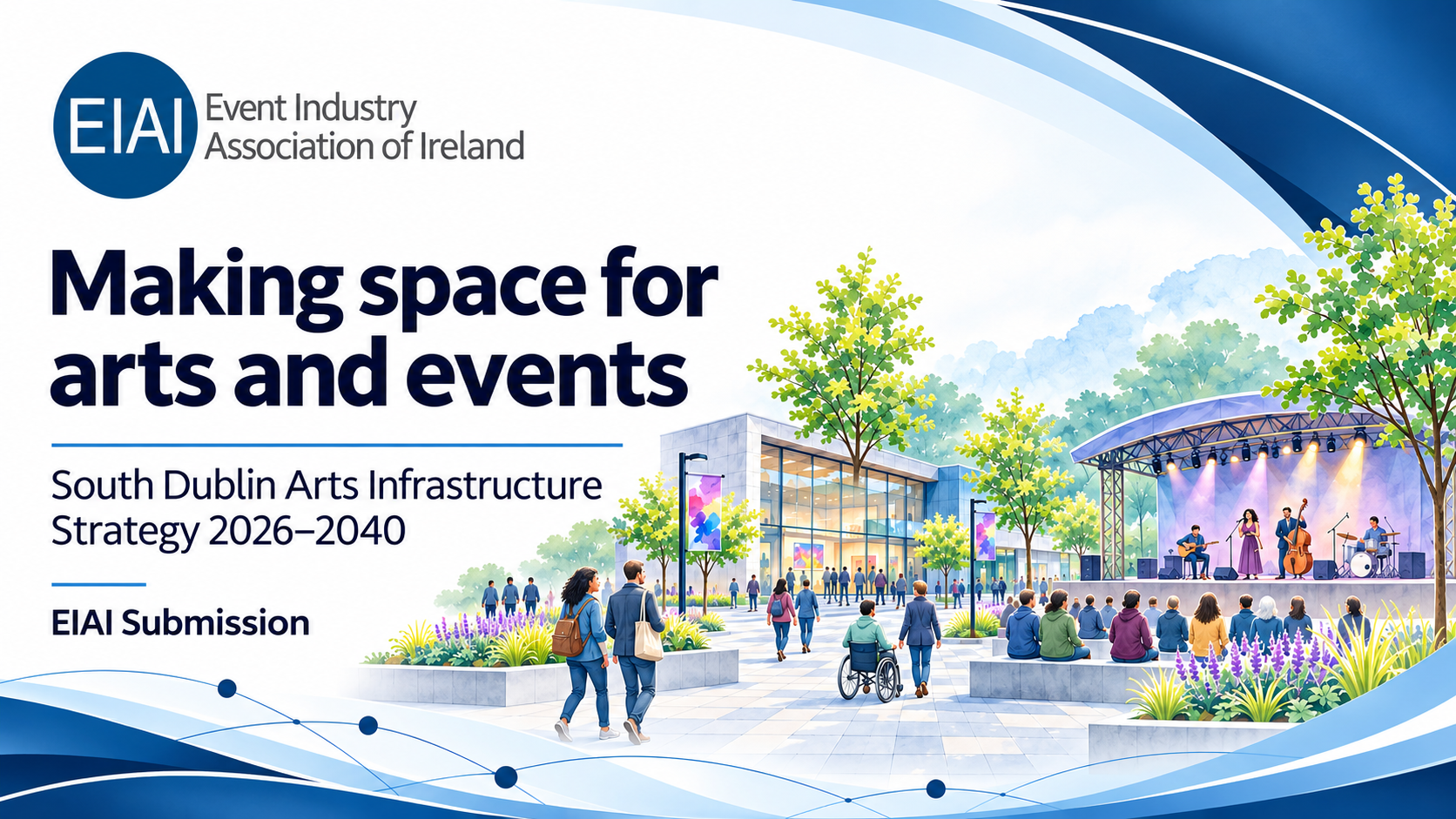
The Event Industry Association of Ireland (EIAI) is calling for festivals, live events and outdoor performance to be explicitly included in South Dublin County Council’s Draft Arts Infrastructure Strategy 2026–2040, with practical measures to ensure cultural investment delivers spaces that communities, artists and event professionals can use. In our submission, EIAI welcomes the Council’s ambition to develop a network of arts hubs, workspaces and specialist facilities across the county. The proposed Music Centre and Centre for Circus, Street Performance and Spectacle, together with improvements to existing venues, offer opportunities to strengthen artistic practice and widen public participation.
The submission makes a clear case for recognising event infrastructure as an integral part of arts infrastructure. Festivals, performances and community celebrations bring artistic activity into parks, streets and neighbourhoods. They can introduce people to cultural experiences, strengthen local identity and create opportunities for participation beyond dedicated arts venues. Delivering those experiences depends on suitable spaces, technical services, skilled workers and workable operating arrangements. EIAI is asking the Council to plan for these needs from feasibility and site selection through design, commissioning and day-to-day management.
The draft recognises open spaces as locations for events and performances, but they were excluded from its infrastructure audit. To strengthen the evidence base and guide investment, EIAI recommends:
- Audit indoor and outdoor event spaces. Establish where cultural activity can take place, what services are available, and which access, booking or operating constraints need to be addressed.
- Measure what spaces can actually deliver. Assess capacity, technical suitability, opening hours, affordability and accessibility alongside floor area.
- Set a county standard for recurring outdoor event sites. Plan suitable services, accessible surfaces, flexible layouts, servicing and temporary infrastructure around each site’s intended use.
- Bring technical expertise into venue design early. Involve production professionals, operators and disabled users before decisions on loading access, acoustics, power, backstage facilities and storage are fixed.
- Test facilities before they open. Confirm that intended event layouts and services work in practice, with clear maintenance responsibilities.
These measures address practical barriers to participation. A public square may be restricted by fixed furniture or inadequate services. An arts room may be unavailable when community groups need it. Understanding these conditions can help the Council make better use of existing assets and target improvements.
The submission also addresses the people, businesses and operating arrangements needed to sustain cultural activity. EIAI’s recommendations include:
- Develop technical and event-delivery skills. Support industry partnerships, professional learning and suitable placements and apprenticeships where approved programmes and host capacity exist.
- Provide affordable production space. Include rehearsal, fabrication and storage in infrastructure planning, alongside a better understanding of the specialist suppliers and independent professionals serving the county.
- Plan for the full cost of operation. Include staffing, technical support, maintenance and equipment replacement, with realistic provision for evening and weekend use.
- Make access and hire arrangements transparent. Publish programming priorities, charges, booking conditions and the routes available to community groups and independent producers.
- Coordinate booking, permissions and planning. Provide a named contact and clear information, address compatibility with neighbouring uses, and establish workable terms for temporary occupation, including costs, tenure and relocation.
Accessibility and sustainability should be built into both the design of spaces and the way events operate. The submission calls for:
- Access across the whole event experience. Consider audiences, artists, staff, contractors and volunteers, including temporary layouts, outdoor conditions, backstage facilities and clear advance information.
- Practical journeys home. Assess evening transport against the times performances and staff shifts actually finish.
- More efficient use of resources. Address energy, water, waste prevention, reuse, transport and procurement, with suitable permanent services where demand and site conditions justify them.
- Shared equipment and facilities. Explore repair and storage provision, supported by realistic management and maintenance arrangements.
To turn the strategy’s ambitions into delivery, EIAI is asking for:
- Clear responsibility and resources: named leads, measurable actions and identified funding requirements.
- Public progress reporting: annual updates showing what has been delivered and what remains outstanding.
- Formal industry participation: an events and night-time industry advisory forum, alongside engagement with artists, communities and disabled people’s organisations.
The submission builds on EIAI’s wider work on public realm design, accessibility and the conditions needed to sustain Ireland’s event industry. In South Dublin, the aim is to connect cultural ambition with the spaces, services, people and operating arrangements through which that ambition reaches communities.
Click here to read the full submission: EIAI – SDCC Draft Arts Infrastructure Submission