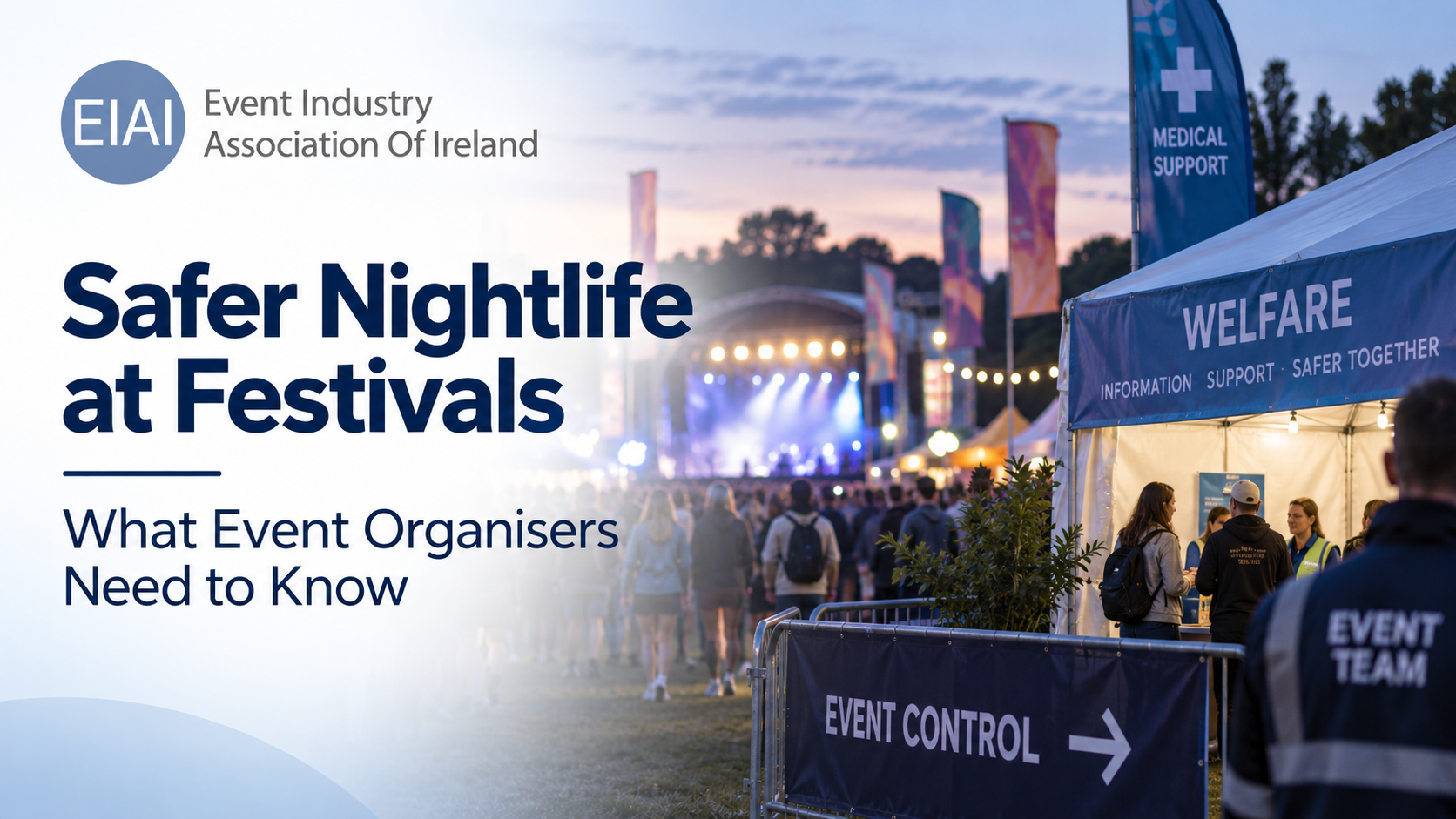
This article is intended for event organisers, safety officers, local authorities and other professionals who need to understand how the HSE’s Safer Nightlife Programme can interact with event operations, medical provision, communications and emergency planning.
The HSE’s latest warning ahead of District X Festival in Kildare is understandably attracting attention because of the substances involved. High-strength MDMA remains in circulation, synthetic cathinones including 3-CMC have been identified being sold as MDMA, and the HSE is monitoring the possible re-emergence of PMA and PMMA in parts of Europe because of the severe toxicity associated with those substances.
For Ireland’s event industry, however, there is another important development within the announcement. The response is no longer limited to issuing public-health advice before an event takes place. The HSE Safer Nightlife Programme is operating at District X on 11 and 12 September, bringing harm-reduction teams and drug monitoring into the event environment itself. Attendees can voluntarily surrender samples for analysis, allowing emerging risks to be identified and, where necessary, communicated while the event is under way.
This represents an increasingly developed model of public-health intervention at festivals and nightlife events, and it raises important questions for organisers about how harm reduction, medical provision, event communications, risk management and emergency planning connect once an event is live.
From public-health messaging to an operational event function
The HSE’s approach is described as “back of house” drug checking, and it is important to understand what that means in practice. This is not a service through which a substance is tested and returned to an individual with an assurance that it is safe. Samples are voluntarily surrendered and analysed so that the HSE can identify trends, unusually potent substances, adulterants or drugs being sold as something else.
At participating festivals, the model can include a drug harm-reduction tent, outreach teams, secure anonymous surrender points and laboratory analysis. Where a substance of particular concern is identified, the resulting intelligence can inform harm-reduction messaging and, where necessary, wider alerts communicated through social media, event screens, apps, harm-reduction workers, medical teams and other appropriate channels.
From an event-management perspective, the significance lies in the fact that this can create a live information loop within the event environment:
Monitoring → identification → assessment → communication → medical and operational response
The important issue for organisers is therefore not the laboratory technology itself, but the way information generated by a public-health service connects with the people who are responsible for managing the event and responding to changing conditions on the ground.
What might this look like in practice?
Consider a situation in which analysis identifies an unusually high-strength MDMA product circulating at a festival. If the HSE determines that a risk communication is appropriate, that information needs to reach the relevant event liaison, medical management and Event Control through the communication arrangements agreed for that event.
The event communications function may then be required to support the distribution of an approved public-health message through available channels, while medical personnel can take the new intelligence into account when assessing presentations. Welfare, security, stewarding and other attendee-facing personnel may also need an appropriate operational briefing so that they understand what signs or behaviours should result in referral to medical services, without being expected to make clinical judgements themselves.
At the same time, Event Control may need to monitor whether medical presentations or related incidents are increasing and, if necessary, activate existing escalation arrangements with the medical provider and relevant statutory services. The precise communication chain will differ between events, but the principle is consistent: information only becomes operationally useful when there is a defined route between the specialist service identifying the concern and the people capable of responding to it.
The drug environment is changing
The immediate reason for the latest HSE intervention is also significant. Recent analysis has identified high-strength MDMA, pills that may look identical but contain very different quantities or substances, and synthetic cathinones including 3-CMC being mis-sold as MDMA. The HSE is also monitoring the reappearance of PMA and PMMA elsewhere in Europe because of the severe toxicity associated with those substances.
This follows earlier warnings in 2026 about changes in the use of MDMA powders and crystals. In March, the HSE reported that these forms could be extremely potent and noted that powders and crystals had become more common than pills among young people.
For event organisers, this matters because previous experience or assumptions about the substances likely to be encountered at a particular type of event may no longer adequately describe the current risk environment. Drug trends can change between seasons and, potentially, relevant intelligence can change during the course of an event itself.
That strengthens the case for medical, welfare and operational arrangements that are capable of adapting to new information, rather than relying entirely on assumptions established during the pre-event planning process.
Connecting public health with the Event Management Plan
The HSE’s Safer Nightlife Programme does not mean that event organisers should attempt to become drug-testing or public-health specialists. Those functions properly belong with qualified agencies and professionals. The organiser’s role is different: where a specialist public-health service is operating within an event, there should be a clear and workable interface between that service and the wider Event Management Plan.
That means understanding in advance who should receive an emerging drug alert, how information is assessed, how medical teams are updated, how attendees can be warned where necessary, what information should be provided to front-line teams and what happens if medical presentations begin to increase.
| Operational question | What should be considered? |
|---|---|
| Who receives an emerging drug alert? | Event Control, medical management and other nominated operational leads, according to the agreed communication structure |
| Who assesses the event implications? | Appropriate liaison between HSE personnel, the event medical provider and Event Control |
| How are attendees warned? | Event screens, apps, social media, public-address systems and direct harm-reduction communication where appropriate |
| How are medics updated? | Rapid communication of relevant substances, symptoms, potency or patterns identified during the event |
| What are front-line personnel told? | Appropriate operational information for welfare, security, stewards and other attendee-facing teams |
| What happens if medical presentations increase? | Defined escalation thresholds, resource review and coordination with relevant statutory services |
| How is information recorded? | Event Control logs, appropriate operational records and medical records within relevant clinical and data-governance arrangements |
| What happens afterwards? | Debriefing, lessons identified and appropriate information sharing between relevant stakeholders |
Not every event will require the same arrangements, and the response should remain proportionate to the nature of the event, audience profile and identified risk. The broader principle, however, extends well beyond drug harm reduction: whenever a specialist agency generates operationally significant intelligence during an event, there should be a defined route through which that information can reach the people capable of assessing and acting upon it.
A governance issue as well as an operational one
There is also an important governance dimension. The presence of a specialist public-health service does not transfer responsibility for event management to that service, nor should the organiser attempt to duplicate the HSE’s professional functions. Instead, the responsibilities and interfaces between organisations need to be sufficiently clear that each party understands what it is responsible for, who it communicates with and what happens when significant information emerges.
Within the risk-management process, this means considering not only the possibility of drug-related medical presentations, but also the arrangements available to identify changing circumstances, communicate relevant intelligence and escalate the event response where necessary.
Within the Event Management Plan, it means ensuring that the medical plan, communications arrangements, Event Control structure, welfare provision and emergency procedures do not operate as isolated components. The same principle applies to the relationship with statutory agencies and local authorities, where effective event management already depends on coordinated planning rather than separate organisations working alongside one another without clearly defined interfaces.
The Safer Nightlife Programme does not create a new event-governance structure. Where it is present, it should connect effectively with the structures that already exist.
Medical provision cannot operate in isolation
There is a useful reminder here about the relationship between medical provision and the wider event operation. An event medical team may be the first part of the event organisation to identify an unusual pattern of presentations, while security or welfare personnel may encounter attendees displaying concerning behaviour before they reach a medical facility. At the same time, a public-health team may hold information about substances circulating at the event that changes the context in which particular symptoms are being assessed.
Those functions become considerably more effective when relevant information can move between them appropriately. The HSE’s earlier evaluation of its Safer Nightlife work described harm-reduction personnel acting as a link between festival attendees, laboratory analysis and on-site medics, allowing information about substances and emerging concerns to move through different stakeholder communication channels.
The programme subsequently generated public risk communications about high-strength MDMA and the emergence of 3-CMC, information which the HSE said would otherwise have gone unrecorded in Ireland. This is therefore not simply a question of placing another service on an event site. It is about connecting services that may each hold different pieces of the same operational picture.
Communications are part of the safety response
The ability to identify an emerging risk has limited value if the information cannot reach the people who need it. The HSE has indicated that where particularly risky substances are identified through its programme, alerts may be communicated through event screens, apps, social media, harm-reduction teams and medical personnel.
From an event-management perspective, this is significant because it places attendee communication within the safety response itself. Once an event is live, communications are not simply promotional or customer-service functions; in certain circumstances they become an operational safety control.
Organisers should therefore understand in advance what communication channels are available, who is authorised to activate them, how externally generated information is verified, how quickly an approved message can be distributed and how information from an external agency reaches the event communications function. These arrangements are considerably easier to establish during planning than during an emerging incident.
Training and briefing the operational team
The presence of Safer Nightlife does not mean that event personnel require specialist training in drug identification. A more useful approach is to ensure that each team understands its own role within the response and knows how to escalate concerns appropriately.
Medical personnel should understand the liaison route with HSE teams and how emerging intelligence will be shared. Event Control personnel should know who can initiate an operational escalation and how significant information will be logged, while welfare, security and stewarding teams should understand when an attendee should be referred for medical assessment and where harm-reduction services are located.
Communications personnel should also understand how an HSE alert would reach them and what authorisation is required before event-controlled communication channels are activated. A short multidisciplinary briefing involving the relevant operational leads may therefore be more valuable than attempting to provide detailed drug information to every member of staff.
The objective is not to turn front-line personnel into public-health specialists, but to ensure that they understand what to recognise, who to contact and what to do next.
What organisers should not do
It is equally important to maintain a clear boundary around the organiser’s role. Event organisers should not attempt to analyse or identify substances themselves unless this forms part of an appropriately qualified and formally governed specialist service, and they should not provide assurances that a substance is “safe” on the basis of its appearance, reported contents or the absence of an alert.
The absence of an HSE warning should not be treated as evidence that substances circulating at an event are safe, nor should unofficial drug-testing activity be incorporated into formal event safety arrangements without appropriate professional and agency governance. Security, stewarding and welfare personnel should not be expected to make clinical judgements that properly belong with medical professionals, and no event procedure should delay or discourage somebody from seeking medical assistance when they become unwell.
The distinction is important because the role of the organiser is to provide an effective operational framework within which the appropriate specialist services can function, rather than attempting to replace those services.
Implications for 2027 festival planning
The continued development of the Safer Nightlife Programme also raises useful planning questions for the 2027 festival season. Where the nature, scale or audience profile of an event means drug-related harm is a material consideration, organisers may wish to consider at an early stage whether engagement with the HSE is appropriate and, where a Safer Nightlife service is expected, how it will interface with the event operation.
That discussion can include the nominated points of contact between the HSE, medical management and Event Control, the communication routes for emerging alerts, attendee communication channels, locations and access arrangements for HSE services, front-line staff briefing, escalation arrangements where medical demand changes and the way in which relevant learning will be captured after the event.
A simple scenario exercise during pre-event planning can also expose gaps that may not be obvious from a written plan alone. Asking what would happen if a high-risk substance were identified at 8.30pm on the busiest night of the event, for example, immediately raises practical questions about who receives the information, who assesses it, who approves communications, how medical and welfare teams are briefed and what circumstances would result in wider escalation.
These are not additional public-health responsibilities for the organiser. They are event-management questions about communication, coordination and command.
Integration with Local Authority planning
For events involving a Local Authority licensing or permissions process, these issues are also relevant to the way organisers present their safety-management arrangements. It would be premature to suggest that participation in the HSE Safer Nightlife Programme is becoming a new national licensing requirement, because that is not the case.
However, the operational issues raised by the programme are already familiar within event planning: risk assessment, medical provision, emergency response, communications, agency liaison, command structures and the management of changing circumstances.
Where a Safer Nightlife service forms part of a particular event, organisers should therefore be able to explain how that service interfaces with the wider Event Management Plan, rather than treating it as an isolated activity taking place elsewhere on the site.
That distinction matters because effective event governance is not achieved by continually adding separate plans and services. It depends on making sure that specialist functions connect coherently with the overall event-management system.
A developing area of event safety
The HSE’s work at District X is not an isolated intervention. The Safer Nightlife Programme has been operating at Irish festivals for a number of years, and the HSE continues to use its back-of-house approach as a means of identifying drug trends and communicating emerging risks within nightlife and festival settings.
For Ireland’s event industry, the more important lesson is therefore not that every organiser should introduce drug checking, nor that organisers should assume responsibilities that properly belong with public-health agencies. The more useful lesson is that event safety increasingly depends on effective interfaces between organisers, specialist contractors, statutory agencies and public services.
Where the HSE is operating a Safer Nightlife service, those interfaces should be considered deliberately: who communicates with whom, what information can trigger an operational response, how medical and welfare teams are informed, how attendees can be reached and how significant developments are incorporated into Event Control.
The changing drug environment also demonstrates why an Event Management Plan cannot simply be regarded as a document completed before the gates open. Some risks evolve in real time, and effective event management requires the structures, responsibilities and communication routes necessary to recognise that change and respond appropriately.
For Ireland’s event industry, the continued development of the HSE Safer Nightlife Programme provides a useful example of what that increasingly integrated approach to event safety can look like.
Sources
HSE, 10 September 2026: HSE warns festival-goers of high-strength MDMA, mis-sold cathinones and PMA/PMMA
Drugs.ie: How the Safer Nightlife back-of-house drug checking programme works
HSE: Safer Nightlife Programme 2022, Results from Back of House Drug Testing
HSE, March 2026: HSE drug warning concerning MDMA powders and crystals