When thousands of spectators are expected to arrive at the same location within a relatively short period, traffic management is about considerably more than directing cars or identifying where temporary signs should be placed. The transport network surrounding an event forms part of the event environment itself, and its capacity, limitations and interaction with the local community can have a significant influence on how an event needs to operate.
The traffic and access arrangements announced for the 2026 Amgen Irish Open at Trump International Golf Links & Hotel in Doonbeg provide an interesting example of this approach in practice.
Taking place from 10 to 13 September on the West Clare coast, the tournament presents an obvious transport challenge. A major international sporting event attracting thousands of spectators is being delivered in a location served predominantly by a rural road network, where attempting to accommodate large volumes of spectator vehicles close to the venue would create significant pressure on the surrounding infrastructure. Rather than simply trying to manage those vehicles when they reach Doonbeg, the traffic strategy is designed to prevent most spectator vehicles from reaching the immediate event area at all.
Park & Ride as part of the event access strategy
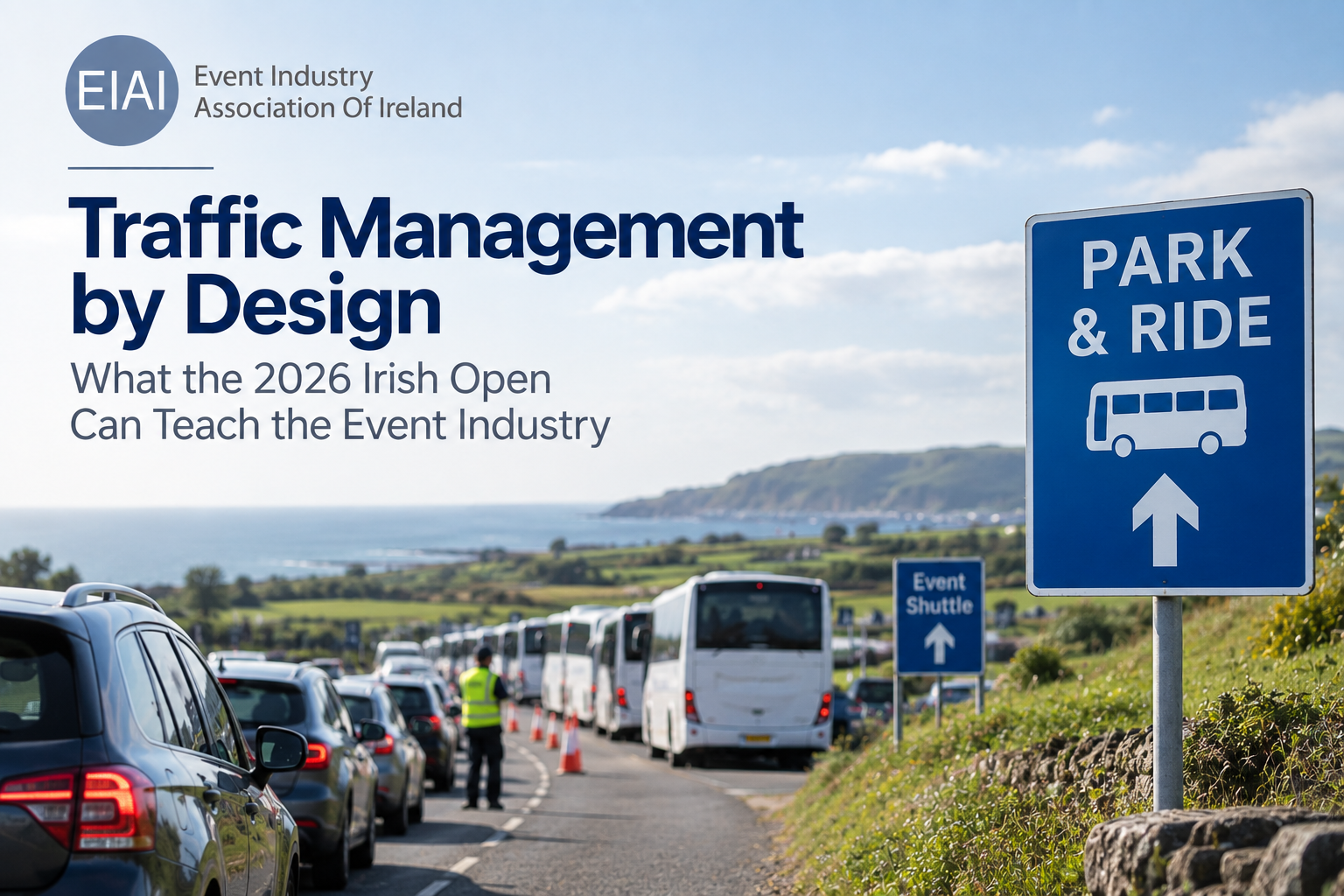
All spectators attending the Irish Open are required to use one of two designated Park & Ride locations, with attendees selecting their Park & Ride location when purchasing their tickets. Spectators are then transported from those locations to the event by shuttle bus, while general spectator parking is not available at or near the golf course and pedestrian access to the event is not permitted.
This makes Park & Ride considerably more than an alternative transport option. It effectively becomes part of the event’s access infrastructure, allowing spectator vehicles to be intercepted before they reach the most constrained parts of the local road network and replacing a large number of individual vehicle movements with a much smaller number of controlled shuttle movements.
For event organisers, there is an important principle in that approach. Where the road network immediately surrounding a venue cannot reasonably accommodate the anticipated volume of event traffic, the solution does not necessarily have to be finding ways to push more vehicles through that network. A more effective solution may be to change where those journeys end and control how spectators complete the final part of their journey.
There is also a sustainability dimension to this approach. Where Park & Ride reduces the distance travelled by individual private vehicles and consolidates onward journeys, it can contribute to lower congestion and transport-related emissions as well as improving operational control. This is consistent with the wider transport rationale for Park & Ride, where intercepting car journeys at an appropriate point can reduce private-car kilometres and the associated emissions and congestion.
Traffic management begins long before the venue entrance
The Garda traffic arrangements also demonstrate how far beyond an event boundary a Traffic Management Plan may need to operate.
An Garda Síochána has advised spectators that the Park & Ride locations are approximately 45 to 60 minutes from Junction 12 at Ennis in normal traffic conditions, with additional journey time expected during the tournament. Attendees are specifically being advised not to rely on Satnav or other navigation systems and instead to follow event traffic signage together with directions provided by Gardaí and traffic stewards.
That is an important operational detail because, during a major event, the route recommended by a navigation application may not be the route that the traffic-management system has been designed to accommodate. The shortest route for an individual vehicle may direct traffic towards a constrained road, create conflicting movements or undermine a wider strategy intended to distribute traffic across the available network.
The effectiveness of the Traffic Management Plan therefore depends partly on communication. Attendees need to know before they travel where they are expected to go, which route they should follow, how much additional time they should allow and why normal navigation instructions may not be appropriate. Traffic information published only when spectators are already approaching the venue may simply arrive too late to influence their behaviour.
Managing the impact on the surrounding community
Large events also have to operate within communities that continue to function while the event is taking place, and the Irish Open arrangements illustrate the importance of considering those movements alongside spectator traffic.
Sections of the N67 and surrounding routes will be subject to restrictions and diversions during the tournament, while arrangements are being maintained for residents and people who have legitimate business within affected areas. Local residents have been issued passes and may be required to provide identification or proof of address at access controls, with Gardaí also engaging directly with residents and businesses affected by the traffic arrangements.
This is an important aspect of event traffic planning because the objective cannot simply be to move spectators efficiently. Residents still need to reach their homes, businesses need to operate, deliveries may need to take place, workers need to travel and people with no connection to the event may need to move through the surrounding area.
A Traffic Management Plan therefore has to consider both the temporary population created by the event and the permanent population surrounding it. In some locations, managing the interaction between those two groups can be just as important as managing the event traffic itself.
Emergency access is part of traffic capacity
The Garda traffic plan also identifies maintaining optimum access for emergency vehicles as one of its objectives, which highlights a particularly important distinction between ordinary congestion management and event traffic management.
A road operating at or close to capacity may still be moving traffic, but that does not necessarily mean it remains operationally suitable for an event. The same routes being used by spectators may be required by ambulances, fire appliances, Garda vehicles or other emergency and operational resources, and an event’s traffic arrangements need to ensure that those movements can continue when they are required.
This means that road capacity should not be assessed solely by asking how many spectator vehicles can physically reach a site. The more important question is whether the transport system can accommodate those movements while preserving the routes and operational flexibility required to respond safely if something goes wrong.
The Irish Open’s use of remote Park & Ride locations helps address that problem by controlling the volume and type of traffic entering the immediate event environment, rather than allowing unrestricted spectator vehicles to reach the venue and attempting to manage the consequences afterwards.
Questions worth asking during event traffic planning
The Irish Open provides a useful prompt for organisers to consider traffic management as part of the early design of an event rather than as a technical document developed once most other decisions have already been made.
| Question | What should be considered? |
|---|---|
| How will spectators reach the event? | Designated routes, Park & Ride, public transport, coaches, taxis and controlled vehicle access |
| Where should private vehicle journeys end? | Whether vehicles can safely reach the site or should be intercepted elsewhere |
| What happens if attendees follow Satnav? | Advance communications, event signage, stewards and traffic controls |
| How will residents and businesses continue to access the area? | Local access arrangements, passes, deliveries and advance engagement |
| Can emergency vehicles move freely? | Protected access, emergency routes and the effect of congestion on response |
| What happens when large numbers leave together? | Departure profiles, shuttle capacity, parking exits and traffic dispersal |
| What happens if the planned route becomes unavailable? | Alternative routes, decision-making responsibilities and communications |
These questions demonstrate why traffic management should connect directly with other elements of an Event Management Plan. Transport decisions can affect emergency planning, crowd arrival profiles, security deployment, stewarding, accessibility, communications and even event opening and closing arrangements.
Designing the event around the available infrastructure
Perhaps the most useful lesson from the Irish Open arrangements is that the surrounding infrastructure should influence how an event is designed.
Where an event site has excellent road and public-transport capacity, the transport strategy may allow spectators considerable flexibility in how they arrive. Where the available infrastructure is constrained, particularly in rural locations, a much more controlled model may be necessary. That could involve remote parking, mandatory shuttle services, designated routes, timed arrivals, coach transport or restrictions on particular forms of access.
None of those measures should automatically be regarded as inconveniences imposed after the event has been planned. They can instead be fundamental parts of the operational design that allow an event to take place safely and successfully in a location that could not otherwise accommodate the movement generated by its audience.
The arrangements for the Irish Open demonstrate that distinction particularly clearly. Rather than asking how thousands of additional vehicles can be accommodated immediately around the venue, the traffic strategy changes the journey itself by intercepting those vehicles elsewhere and controlling the final movement of spectators into the event.
There is a wider governance point here too. Ireland’s event licensing framework requires traffic management to be addressed within event planning, but there is not currently a single, nationally maintained model setting out how event traffic planning should be approached across different site types and operating environments. Practical examples such as the Irish Open are therefore particularly valuable because they demonstrate how the principles can be translated into an operational system appropriate to a specific location.
For organisers planning events in locations with constrained transport infrastructure, the lesson is that these issues should be considered at the earliest stages of planning. A Traffic Management Plan should not simply describe how traffic will be managed once the event has been designed; in the right circumstances, the limitations of the transport network should help determine how the event is designed in the first place.
This type of design-led, integrated thinking, where transport, safety, community impact, sustainability and event operations are planned as interconnected systems, is something Ireland’s event industry should be seeking to apply more consistently.
The 2026 Amgen Irish Open takes place at Trump International Golf Links & Hotel, Doonbeg, Co. Clare from 10 to 13 September 2026. The traffic and access arrangements referenced in this article are based on information published by An Garda Síochána on 7 September 2026.