EIAI’s submission on the Carlow Link Streets Public Realm Enhancement Project calls for event requirements to inform public realm investment from the outset, ensuring that improved streets and public spaces can accommodate community, cultural and commercial activity safely, accessibly and sustainably.
Public realm investment shapes how a town functions for many years, influencing how people move through its streets, spend time in its public spaces and participate in community life. For Carlow, the proposed Link Streets Public Realm Enhancement Project provides an opportunity to consider how everyday improvements to paving, planting, seating and accessibility can also support the markets, performances, parades and celebrations that bring people together and contribute to local business activity.
The Event Industry Association of Ireland (EIAI) supports the project’s ambition to create a more accessible, attractive and welcoming town centre, and our submission focuses on the practical design and management decisions that will determine how successfully the completed spaces can accommodate their intended activities. Where event use is anticipated, the infrastructure, access arrangements and operational requirements should be considered before designs are finalised, when they can be incorporated into the wider works and coordinated with the needs of residents, businesses and everyday users.
Providing permanent services during the planned works
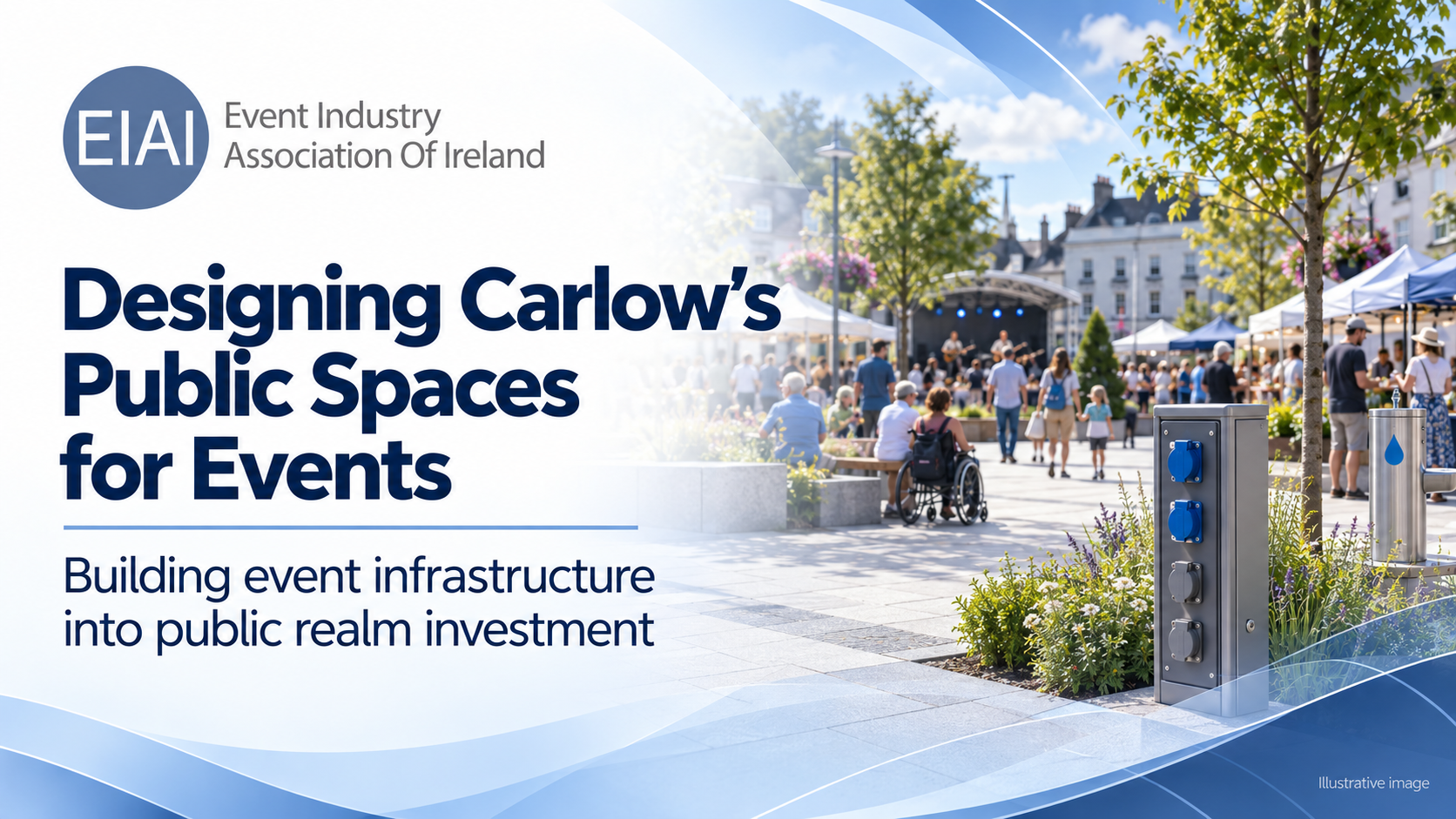
One of the submission’s central recommendations is that dedicated event power and water connections should be incorporated wherever streets or spaces are intended to accommodate events, taking advantage of the excavation, resurfacing and service diversions already proposed. Although the M&E Planning Report describes street-lighting infrastructure and existing utilities, dedicated event supplies are not clearly identified in its written proposals, and EIAI is asking the Council to confirm their inclusion before detailed design and construction arrangements are finalised.
Installing these services during the current works would avoid the expense of reopening completed streets, the disruption that further excavation would cause to residents and businesses, and the potential damage to newly laid paving and landscaping. For organisers, reliable supplies available on reasonable terms could also reduce recurring expenditure on generator hire, fuel, transported water and temporary installations, helping to make community and cultural programming more affordable.
The environmental case is closely connected to these economic considerations, because avoiding repeated excavation reduces material consumption, construction waste and vehicle movements, while appropriately sized electricity connections can reduce reliance on diesel generators. Potable water connections can support refill facilities and reduce the need for transported supplies, provided that access, maintenance and charging arrangements make permanent infrastructure a practical option for the people delivering events.
Testing how public spaces will work in practice
The usefulness of an event space depends on the relationship between its layout, infrastructure and surrounding activity, with trees, seating, planters, bollards, loading bays and pedestrian routes all influencing what can safely take place. Gross surface area alone does not establish event capacity, which is why EIAI recommends testing representative community, market, performance and civic layouts during design, including the space required for installation, servicing, audiences, queues, temporary facilities and emergency access.
Where parade or procession use is intended, this assessment should extend to assembly and dispersal areas, turning movements, spectator positions and overhead clearance, taking account of anticipated floats and support vehicles as well as the effect of planting as it matures. These considerations are particularly relevant where a project changes kerb lines, street furniture or access arrangements that established events may already depend upon.
In Carlow, testing must reflect the constraints identified in the Project Infrastructure Audit, including narrow footpaths, loading difficulties and the dependence of future pedestrianisation on interventions outside the present project boundary. Each location should therefore be assessed for activities appropriate to its scale and circumstances, with the proposed Charlotte Street/Brown Street pocket park, for example, considered for uses that complement its planting, seating, play features and everyday recreational purpose.
Publishing verified site maps would give organisers a reliable basis for planning, showing dimensions, fixed features, utility locations, loading constraints and accessible routes, while clearly distinguishing Council-provided information from matters requiring event-specific confirmation. Supported by a named owner and an updating process, this information could reduce repeated surveys and duplicated reports, while practical commissioning trials before handover would help establish whether the completed works meet the agreed operational brief.
Balancing flexibility, accessibility and everyday amenity
Seating, planting and other permanent features make an important contribution to a welcoming town centre, and their placement should account for both everyday use and activities that periodically require a different arrangement. EIAI recommends reviewing these elements against tested event layouts and considering removable or retractable furniture where appropriate, with clear responsibilities for handling, storage, inspection, maintenance and reinstatement so that flexibility remains workable throughout the infrastructure’s lifetime.
Accessibility also needs to be tested with audiences and temporary equipment in position, because a route that functions well on an ordinary day may become obstructed by queues, stalls or installations during an event. Planning should consider the complete journey from transport and accessible set-down points to activity areas, viewing positions, toilets and exits, involving disabled people and representative organisations and providing accurate advance information about facilities and temporary changes.
For evening activity, lighting, wayfinding and transport arrangements should support safe arrival and departure, including for workers who remain after audiences have left, while sound, servicing and breakdown arrangements should respect nearby residents and businesses. Heritage, planting and drainage require similar attention, ensuring that temporary activity protects historic fabric, tree roots and rain gardens and that wastewater and cleaning operations are appropriately managed.
Connecting investment with clear operating arrangements
Even well-designed infrastructure can be difficult to use if organisers cannot establish who to contact, which permissions apply, what information is required or how much access will cost. EIAI therefore proposes a coordinated event pathway connecting Council guidance, application forms, verified site information, utilities and temporary traffic arrangements, allowing organisers to reuse information through a clear coordinating contact while retaining the distinct requirements of the relevant permissions.
Transparent charges should enable organisers to understand the full cost of using a space before committing to an event, including utility consumption, furniture removal, cleaning, closures and deposits, with proportionate arrangements that support community groups and smaller organisers. Clear responsibilities for Council assets and organiser activities would also help avoid uncertainty about infrastructure condition, authorised connections, maintenance and reinstatement.
The same practical approach should inform delivery and long-term funding, with established event organisers involved before construction programmes are fixed so that changes to routes, servicing and infrastructure can be understood and suitable alternatives agreed where necessary. Named asset owners, multi-year maintenance and replacement planning, and feedback from organisers, residents, businesses and accessibility representatives would help ensure that the initial investment continues to provide value as patterns of use develop.
Carlow’s public realm investment offers an opportunity to make community and cultural activity easier to deliver for years to come, provided that the requirements of those activities are incorporated into design, construction and ongoing management. EIAI welcomes continued engagement with Carlow County Council and the project team and is available to contribute practical national event industry expertise to support public spaces that serve their communities safely, inclusively and sustainably.
Read EIAI’s full submission: EIAI – Submission on the Proposed Carlow County Council Public Realm Enhancement Project 02112026
The project documents are available through Carlow County Council’s consultation portal: https://consult.carlow.ie/en/consultation/consultation-part-viii-planning-application-carlow-link-streets-public-realm-enhancement-project.