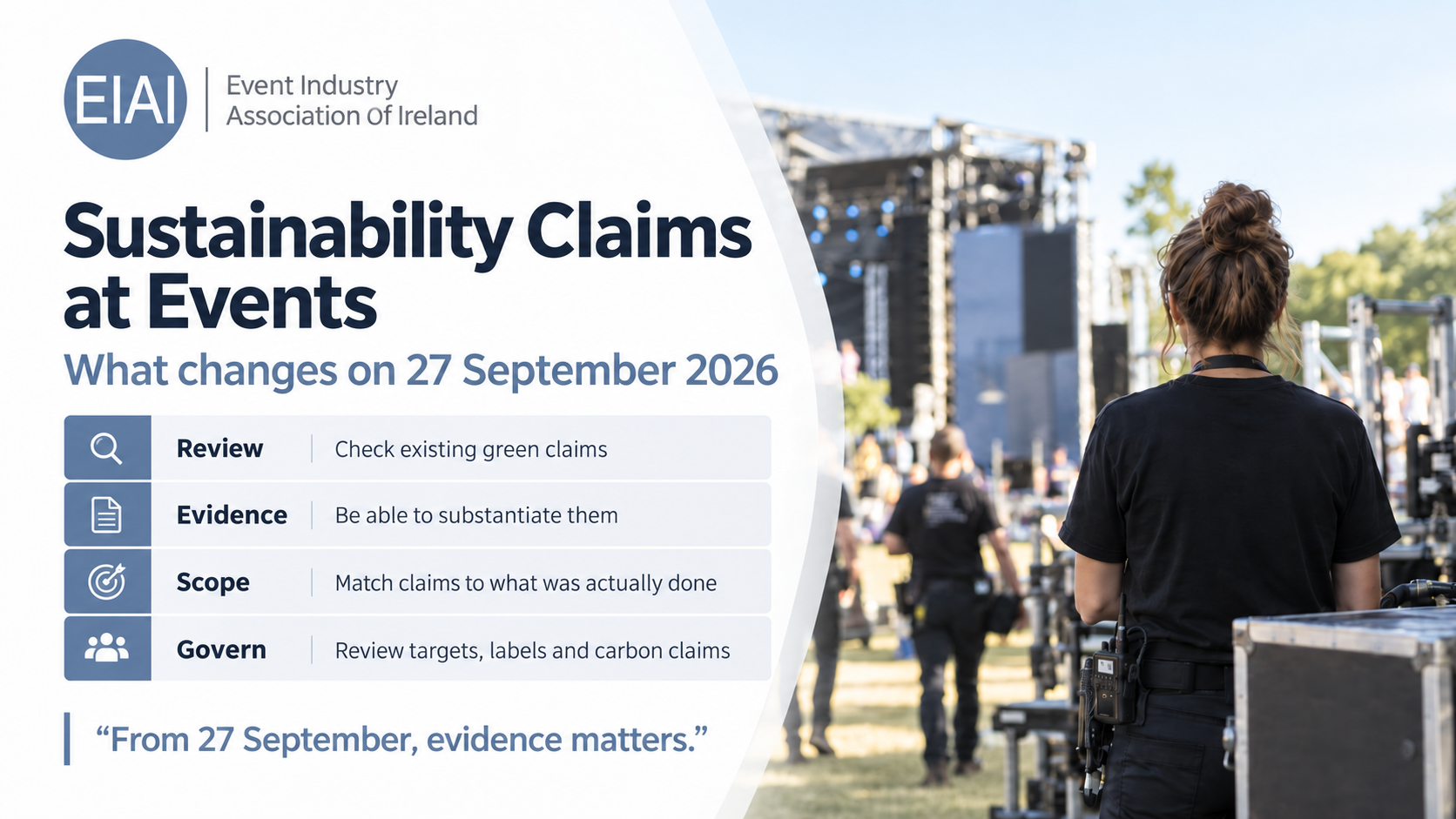
Sustainability is now a core part of event planning in Ireland. Organisers are reducing waste, improving transport options, changing energy sources, removing unnecessary single-use materials, strengthening procurement and measuring environmental performance. Audiences, funders, sponsors and other stakeholders increasingly expect clear communication about this work. From 27 September 2026, the language used to communicate environmental performance becomes even more important. Ireland’s European Union (Empowering Consumers for the Green Transition) Regulations 2026, S.I. No. 124 of 2026, take effect on that date, amending the Consumer Protection Act 2007 and Consumer Rights Act 2022 and introducing more explicit rules around environmental claims, sustainability labels and environmental promises made by businesses.
For the event industry, the message is not that sustainability should become harder to talk about. It is that environmental claims increasingly need to be specific, measurable and capable of being substantiated. That matters across event websites, ticketing pages, advertising, social media, promotional campaigns and other consumer-facing communications.
What changes on 27 September?
The new rules implement Directive (EU) 2024/825 on Empowering Consumers for the Green Transition. The Competition and Consumer Protection Commission has explained that traders will be required to provide clearer and more accurate information, particularly in relation to environmental claims, while the Department of Enterprise, Tourism and Employment has highlighted the objective of protecting consumers against practices including greenwashing and unreliable sustainability labels.
Misleading environmental advertising has not suddenly become unlawful from 27 September. Ireland’s existing consumer protection framework already prohibits misleading commercial practices, and environmental claims are also addressed within advertising standards. What changes is that a number of environmental practices are now dealt with much more explicitly in Irish consumer law.
These include generic environmental claims where the trader cannot demonstrate recognised excellent environmental performance relevant to the claim, claims about an entire product or business where the environmental benefit actually relates only to one aspect or activity, certain carbon neutrality or reduced climate impact claims based on greenhouse gas offsetting, unreliable sustainability labels, and environmental promises about future performance that are not supported by detailed and measurable plans.
For event organisers, that creates a clear need to look not only at what environmental improvements are being made, but also at how those improvements are described.
Moving beyond broad claims such as “sustainable event”
Generic environmental terms such as green, eco-friendly and climate-friendly are specifically contemplated by the new European framework. The Directive provides that generic environmental claims should not be used unless the trader can demonstrate recognised excellent environmental performance relevant to the claim. It also highlights terms such as sustainable and responsible, which may imply characteristics extending beyond environmental performance alone.
For events, the practical implication is that specific information is likely to be far more useful than broad environmental branding. Rather than simply describing a festival as “sustainable”, an organiser might explain that a defined percentage of waste was diverted from residual disposal, that electricity for a particular area came from a certified renewable supply, or that reusable cups replaced single-use cups at all organiser-operated bars.
Those statements still need to be accurate and supportable, but they explain what actually happened, where it happened and, where appropriate, how it was measured. That gives audiences considerably more meaningful information than a general claim that an event is simply “green”.
One environmental initiative does not necessarily describe the whole event
Organisers should also be careful about turning a successful initiative in one area into a claim about the environmental performance of the entire event. Introducing reusable cups, installing water refill stations, providing a bike park or using renewable electricity in part of an event site are all positive measures. The difficulty arises where one of those measures is used to imply a much broader environmental outcome than the evidence actually supports.
The Regulations specifically address claims about an entire product or business where the environmental claim actually concerns only a particular aspect or activity. In an event context, an organiser using renewable electricity for a main stage should therefore be cautious about suggesting that an entire festival is powered by renewable energy if generators or other areas continue to use different energy sources. In the same way, compostable serviceware in one catering area does not necessarily make an entire event plastic free.
The practical lesson is fairly simple: define the scope of the claim and make sure the language matches the evidence.
Carbon neutral claims require particular care
The new rules are especially significant where carbon claims depend on offsetting. The Regulations prohibit certain claims, based on the offsetting of greenhouse gas emissions, that a product has a neutral, reduced or positive environmental impact in terms of greenhouse gas emissions. Under Irish consumer law, the concept of a product includes services as well as goods, making this relevant to the event industry.
The underlying EU Directive gives examples including terms such as “climate neutral”, “carbon positive”, “climate net zero” and “climate compensated” where those claims are based on offsetting. This does not mean that organisations are prevented from investing in environmental projects or purchasing carbon credits, but they need to be careful about what those activities are said to demonstrate.
For a major event, the distinction could be particularly important. Audience travel, artist transport, freight, temporary power, accommodation, catering, production and waste can all contribute to the overall emissions profile. Purchasing offsets does not remove the need to understand and communicate the underlying environmental impact accurately.
Future environmental promises need a plan behind them
The Regulations also address claims about future environmental performance. This could affect recurring statements by events, venues and promoters that they intend to become carbon neutral, net zero, zero waste or fully sustainable by a particular year. A future environmental target cannot simply operate as an aspirational marketing statement if it is being presented to consumers as an environmental commitment. The new provisions require future environmental claims to be supported by clear, objective, publicly available and verifiable commitments contained within a detailed and realistic implementation plan.
That plan needs measurable and time-bound targets and the other elements necessary to support delivery, including appropriate allocation of resources. The framework also provides for regular verification by an independent third-party expert, with findings made available to consumers. For the event industry, this creates an important distinction between setting an ambition and making an environmental performance claim. There is nothing wrong with organisations setting ambitious long-term goals, but if those ambitions become part of consumer-facing marketing, the governance behind them becomes increasingly important.
Sustainability labels and badges also need scrutiny
Events increasingly display environmental accreditations, sustainability badges, standards and other marks on websites, programmes and promotional materials. Some are independently certified, while others may have been developed internally or provided through commercial schemes. The Regulations specifically address sustainability labels and prohibit their use unless they are based on an appropriate certification scheme or established by a public body. Organisers therefore need to understand what sits behind any environmental badge or certification they display.
That means knowing who created the scheme, what criteria it uses, whether compliance is independently assessed and what exactly the certification covers. It is also important to understand whether a badge applies to the event itself, the venue, the organiser, a supplier or a particular product or service. Those distinctions can easily disappear once a logo appears on a public-facing event page. Again, this is increasingly a governance issue rather than simply a marketing or design decision.
This should not stop events talking about sustainability
There is a potential downside to tighter rules around environmental claims if organisations become so concerned about greenwashing that they stop talking about environmental improvements altogether. That would be the wrong outcome. Audiences should know when organisers are reducing waste, improving public transport options, measuring power consumption, increasing reuse, improving water management or changing procurement practices. Sharing credible environmental performance can encourage audiences to participate and can help good practice spread across the event industry.
The better response is therefore not to communicate less, but to communicate more accurately. Broad statements can be replaced with specific information, assumptions with measurement and general environmental branding with evidence of actual performance. Where progress is still underway, organisers can say that too. An event does not need to claim environmental perfection in order to demonstrate genuine improvement.
What should event organisers do before 27 September?
With the Regulations taking effect on 27 September 2026, event organisations have an opportunity to review their existing consumer-facing environmental communications now.
| Action | What this means for events |
|---|---|
| Review | Check websites, ticketing pages, social media, advertising, signage and promotional material for broad environmental claims such as green, sustainable, eco-friendly, carbon neutral, net zero or zero waste. |
| Evidence | Identify what evidence supports each claim, including waste reports, energy data, transport information, procurement records, supplier documentation or certification. |
| Scope | Make sure the wording reflects exactly what the environmental measure covers. A successful initiative in one area should not imply an environmental benefit across the entire event. |
| Govern | Review future targets, labels and carbon claims, establish who is responsible for them and ensure evidence is captured during planning, delivery and post-event review. |
The review should consider not only the words being used but what an ordinary audience member is likely to understand from them. For each claim, organisers should ask what evidence exists to support it and whether the scope accurately reflects what has actually happened.
Carbon claims and future environmental targets deserve particular attention, as do sustainability badges and certifications. Organisations should understand both the basis of the claim and who within the organisation is responsible for ensuring that it remains accurate.
Most importantly, environmental evidence should increasingly be designed into event planning and post-event review. Data collection should not begin when somebody starts writing the sustainability section of next year’s marketing campaign. If organisers want to communicate environmental performance credibly, the information required to support those claims needs to be captured during planning, delivery and debrief.
Sustainability is becoming a governance issue
The September changes are part of a wider transition already taking place across the event industry. Sustainability is moving from being primarily a statement of intention towards an area that requires planning, measurement, evidence and accountability.
That should not be viewed negatively, the event industry already operates in an environment where important claims about safety, capacity, accessibility, infrastructure and operational readiness need to be supported by evidence. Environmental performance is increasingly moving in the same direction.
If an organiser wants to demonstrate that waste has fallen, it needs a reliable baseline and measurement. If an event wants to show that more people are arriving by public transport, it needs data. If a festival wants to reduce generator fuel consumption, it needs to understand current usage. If an organisation establishes a five-year environmental target, it needs ownership, milestones and a credible way of assessing progress.
The central issue is therefore not whether events should talk about sustainability. They absolutely should. The question is whether the environmental claims being made to audiences accurately reflect the work that has actually been done.
From 27 September, that distinction becomes even more important. For event organisers, the most credible sustainability message will increasingly be one that can explain not simply what an event hopes to achieve, but what changed, how it was measured and what evidence supports the claim.
This article provides general industry information and is not legal advice.