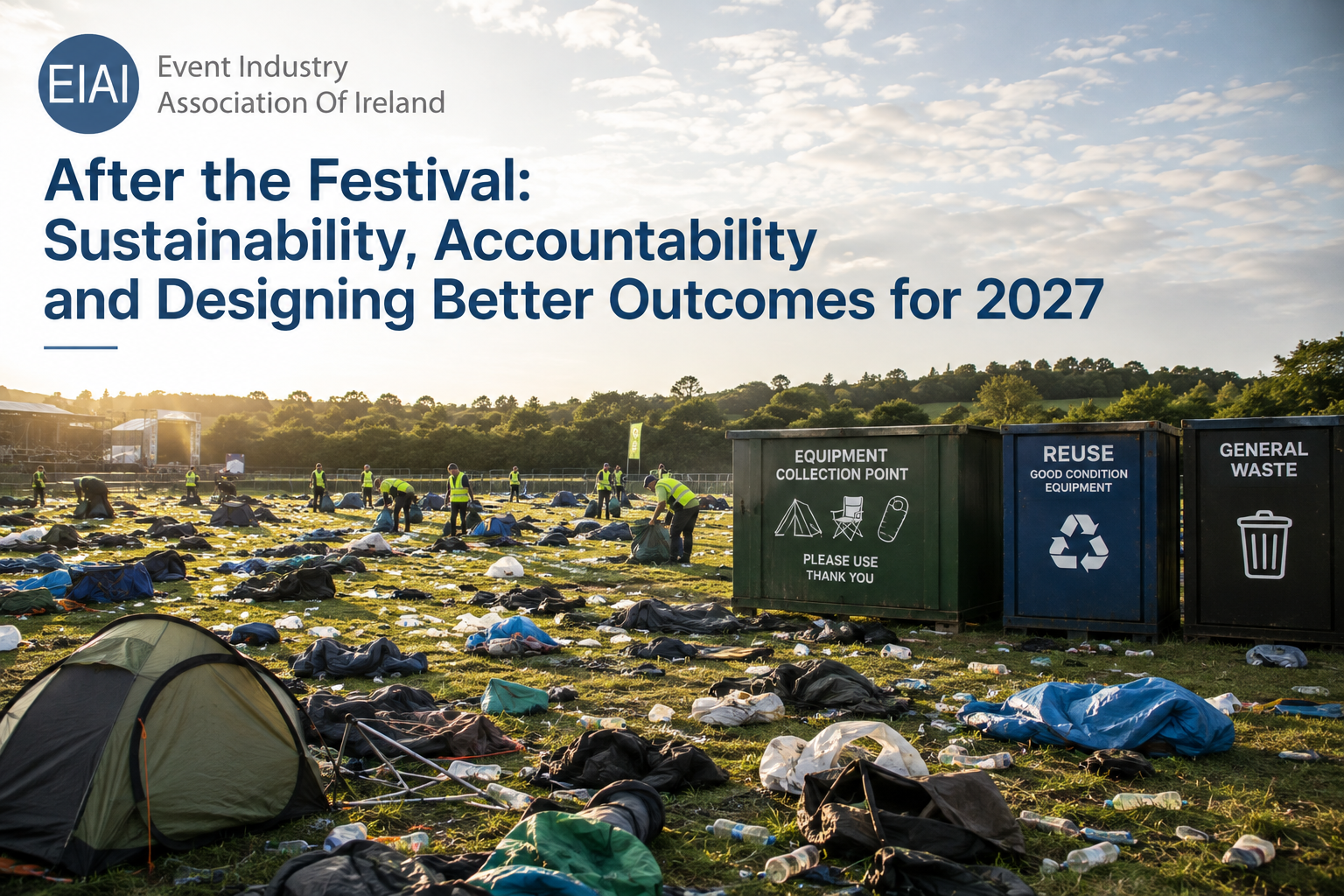
Images of the aftermath of Reading Festival have travelled extraordinarily far over the past few days, showing abandoned tents, camping equipment and waste scattered across a festival campsite after audiences had departed. The reaction has been predictable; anger at festival-goers, arguments about disposable culture, criticism of organisers, defences of people packing up after several days of camping, and, inevitably, a social media debate in which responsibility is assigned almost entirely to one side or the other.
For those of us working in Ireland’s events industry, however, the images should prompt a more useful conversation. Because this is not simply a Reading problem, nor is it solely a UK problem. The aftermath of festival weekends in Ireland can present many of the same challenges. Tents, sleeping bags, chairs, camping equipment, packaging, food and other materials can remain after audiences have gone home. Irish commentary on festival sustainability has been highlighting the problem of abandoned equipment and avoidable campsite waste for years.
As the 2026 summer festival season comes to an end and planning for 2027 begins, perhaps the question should not simply be why people continue to leave things behind. A more useful question is this:
If we continue seeing similar outcomes, how do we design better ones?
Sustainability cannot stop at the communications plan
Most festival organisers now understand the importance of sustainability, audiences are encouraged to use public transport, bring reusable bottles, recycle their waste, return reusable cups and take their tents and belongings home – those messages matter, but communication alone cannot carry the entire sustainability strategy.
A large outdoor festival is effectively a temporary settlement. For several days, organisers create power networks, sanitation systems, campsites, food and beverage operations, transport arrangements, waste infrastructure, temporary structures and public spaces for thousands or tens of thousands of people. When the event finishes, much of that temporary environment has to disappear again within an extraordinarily short period.
The environmental consequences of those decisions therefore begin long before anyone drops a drinks container on the ground or leaves a tent behind. They begin with:
- procurement,
- transport planning,
- the materials permitted onto a site,
- trader and supplier requirements,
- campsite design,
- power choices,
- how waste streams are configured,
- the products audiences are encouraged to purchase, and
- how easily people can make the sustainable choice when it is time to leave.
Fáilte Ireland’s Sustainable Festivals Guidelines already recognise this broader approach. The framework covers seven areas: energy, travel and transport, resources, food and beverage, water, nature and biodiversity, and governance. Importantly, it also recognises that large outdoor and camping festivals present different sustainability challenges because of the scale of infrastructure, suppliers and stakeholders involved. Ireland therefore does not lack sustainability guidance, the challenge for the next phase is increasingly about turning guidance into measurable operational outcomes.
Personal responsibility still matters
There is a danger in discussing systems and operational design that individual responsibility disappears from the conversation, it should not. Leaving a perfectly usable tent, sleeping bag, chair or other equipment behind because carrying it home is inconvenient is still a choice, festival attendees have responsibilities too. But acknowledging personal responsibility does not prevent organisers from asking whether the environment surrounding those choices can be improved – that distinction matters.
The events industry routinely designs systems around foreseeable human behaviour. We provide barriers because crowds need to be managed. We provide signage because people need directions. We develop traffic plans because thousands of vehicles cannot simply be expected to organise themselves. We position welfare facilities because people need access to help.
Sustainability deserves the same operational thinking. Telling someone to “take your tent home” is necessary, the next question is whether we have designed properly for the people who, despite all of that messaging, are still going to leave equipment behind.
We spend enormous amounts of time designing festivals for the moment when the gates open. Perhaps we need to spend more time designing them for the moment when the gates close. The Monday morning experience is particularly important at camping festivals. Audiences may be exhausted, equipment may be wet or muddy, weather conditions may have deteriorated, and people may be carrying several days’ worth of belongings while walking significant distances towards car parks, shuttle buses or public transport.
None of this excuses littering or the deliberate abandonment of equipment, but it is precisely the type of operational reality that good event planning is supposed to anticipate. We should continue encouraging festival-goers to take tents, chairs, sleeping bags and other equipment home. But we should also acknowledge that some people will not. If an attendee has already decided that a tent or piece of camping equipment is being left behind, where are we asking them to put it?
Could clearly designated equipment collection points, skips or surrender areas be introduced during the departure phase, allowing unwanted items to be gathered in controlled locations rather than abandoned across a campsite? Could reusable equipment be separated from genuine waste before it becomes damaged or contaminated during site clearance?
These facilities would need to be carefully designed around fire safety, emergency access, waste segregation, vehicle movements and contractor operations. But these are event-management questions, and they are capable of being planned for.
There is a difference between accepting undesirable behaviour and planning for foreseeable behaviour.
If experience tells us that some equipment will be abandoned regardless of the messaging, then the question for 2027 is whether we can manage that reality better. So alongside asking whether audiences have received sufficient sustainability messaging, organisers could increasingly ask:
What does the sustainable departure journey actually look like?
- Could campsite layouts make movement of equipment easier?
- Could baggage assistance or collection points help people using public transport?
- Could viable equipment be directed into properly managed reuse or donation channels before it becomes mixed waste?
- Could rental or pre-pitched camping models reduce the volume of inexpensive equipment being purchased for a single weekend?
- Could stronger relationships with camping-equipment retailers create effective return, repair or take-back programmes?
- Could incentives or deposits influence behaviour?
- Could departure communications begin before the final night rather than appearing when people are already packing?
- Could clearly differentiated reuse, salvage and waste facilities remain highly visible during the departure period?
There will not be one solution suitable for every event, but there is considerable scope for experimentation.
Waste should be designed out before it has to be collected
The most visible sustainability challenge is often waste because it is what remains on the ground when the audience disappears. But cleaning a site efficiently is not the same thing as preventing waste – that is an important distinction.
An excellent waste contractor can remove enormous quantities of material after an event, that does not necessarily mean the event has achieved an excellent environmental outcome. The better question is how much of that material needed to become waste in the first place.
Fáilte Ireland encourages festival organisers to move beyond disposal and consider the full lifecycle of resources, including purchasing decisions, reuse, waste segregation, contractor reporting and the measurement of waste streams. For organisers, that potentially means looking upstream:
- What are traders bringing onto the site?
- What packaging is permitted?
- What are sponsors distributing?
- What is being purchased backstage?
- Which materials repeatedly appear in post-event waste reports?
- Which supposedly reusable products are actually being treated as disposable?
- Where can rental replace ownership?
- Where can reuse replace disposal?
- And where could a procurement requirement prevent a problem before the gates ever open?
This is where sustainability starts becoming an event-management discipline rather than an environmental add-on.
Measure what happened, not only what was promised
Perhaps one of the biggest opportunities for 2027 is measurement. A sustainability policy can be impressive, A sustainability report is considerably more useful. Festivals will naturally differ in their environmental impacts according to size, location, audience, duration and format, so simplistic league tables would achieve very little. But organisers themselves can establish meaningful year-on-year baselines;
- How much waste was generated per attendee?
- What proportion entered each waste stream?
- How much equipment was abandoned?
- How much fuel was consumed?
- How much temporary power was required?
- What proportion of audiences travelled using public or shared transport?
- Which sustainability interventions performed well?
- Where did contamination occur?
- Which suppliers or operational areas created unexpected problems?
- And, perhaps most importantly: What will we do differently next year?
Fáilte Ireland’s guidance explicitly encourages festivals to gather environmental data, develop targets and integrate sustainability across the festival team rather than treating it as the responsibility of one isolated individual. That kind of measurement allows sustainability to become part of the event’s continuous improvement process.
- Plan.
- Deliver.
- Measure.
- Review.
- Improve.
- Then do it again.
Accountability does not have to mean blame
This is also where we need to be careful about the language of accountability. The objective should not be to photograph an Irish festival campsite on Monday morning, publish the worst-looking image possible and declare that an organiser has failed.
- Events differ enormously.
- Weather differs.
- Sites differ.
- Transport infrastructure differs.
- Audience demographics differ.
- Resources differ.
Organisers cannot personally control every decision made by tens of thousands of individuals, accountability should instead mean being willing to understand the outcome.
- What worked?
- What did not?
- What did we generate?
- Where did it go?
- Did the intervention we introduced actually change behaviour?
- Did our suppliers deliver what was expected?
- What did the post-event operation tell us that the pre-event sustainability plan did not?
- And what are we going to change?
That is a much more mature sustainability conversation than either blaming audiences for everything or expecting organisers to somehow eliminate every piece of waste generated by the people attending their events. It recognises shared responsibility, but it also recognises that professional event organisers are uniquely positioned to design the systems within which those individual decisions are made.
Ireland has an opportunity
There is already considerable sustainability work taking place across the Irish events sector. Fáilte Ireland provides dedicated sustainable festival guidance and currently positions sustainability alongside the operational supports available to festival and event organisers. Its current outdoor-event guidance also encourages organisers to minimise single-use plastics, provide clearly segregated waste facilities, consider the sustainability of participant materials, address biodiversity, redistribute excess food where possible and promote sustainable transport.
Sustainability planning is also becoming increasingly embedded in the structures surrounding events. Fáilte Ireland’s current Strategic Festival Investment Scheme, for example, includes sustainability planning among the information expected as part of the funding process, the foundations exist.
What would be valuable now is greater industry-wide sharing of what actually works, not another campaign telling people that littering is bad, not another generic commitment to “be greener”, practical evidence.
- What intervention materially reduced campsite waste?
- Which transport initiative shifted audience behaviour?
- Which reusable system achieved the highest return rates?
- Which procurement restrictions genuinely reduced material entering the waste stream?
- Which initiatives sounded promising but proved impractical?
- What did organisers learn from severe weather?
- How were sustainability requirements incorporated into supplier contracts?
- How was environmental performance measured?
The events industry is exceptionally good at sharing operational learning in areas such as safety, production, crowd management and technical delivery. Sustainability should increasingly receive the same treatment.
Towards better solutions in 2027
The extraordinary reach of the Reading Festival footage tells us something, images of festival waste provoke people because the contradiction is impossible to miss. For a few days, enormous amounts of skill, creativity, infrastructure and investment are assembled to create an extraordinary shared experience. Then the audience leaves, and what remains can tell a very different story. But outrage by itself will not solve that problem, neither will another sign telling people to take their tent home.
The opportunity for the Irish events industry in 2027 is to continue moving from green messaging towards sustainable event design, supported by measurement, operational learning and shared accountability:
- Audiences have a responsibility.
- Organisers have a responsibility.
- Suppliers, traders, contractors and commercial partners have responsibilities too.
The strongest outcomes will come when those responsibilities are understood as parts of the same system. As another summer season comes to an end, now is the time to look at what happened, identify where the gaps remain and share the solutions that worked. Twenty-five million views of an abandoned festival campsite can generate an enormous amount of outrage.
The more valuable legacy would be ensuring that, next summer, there is considerably less to photograph.