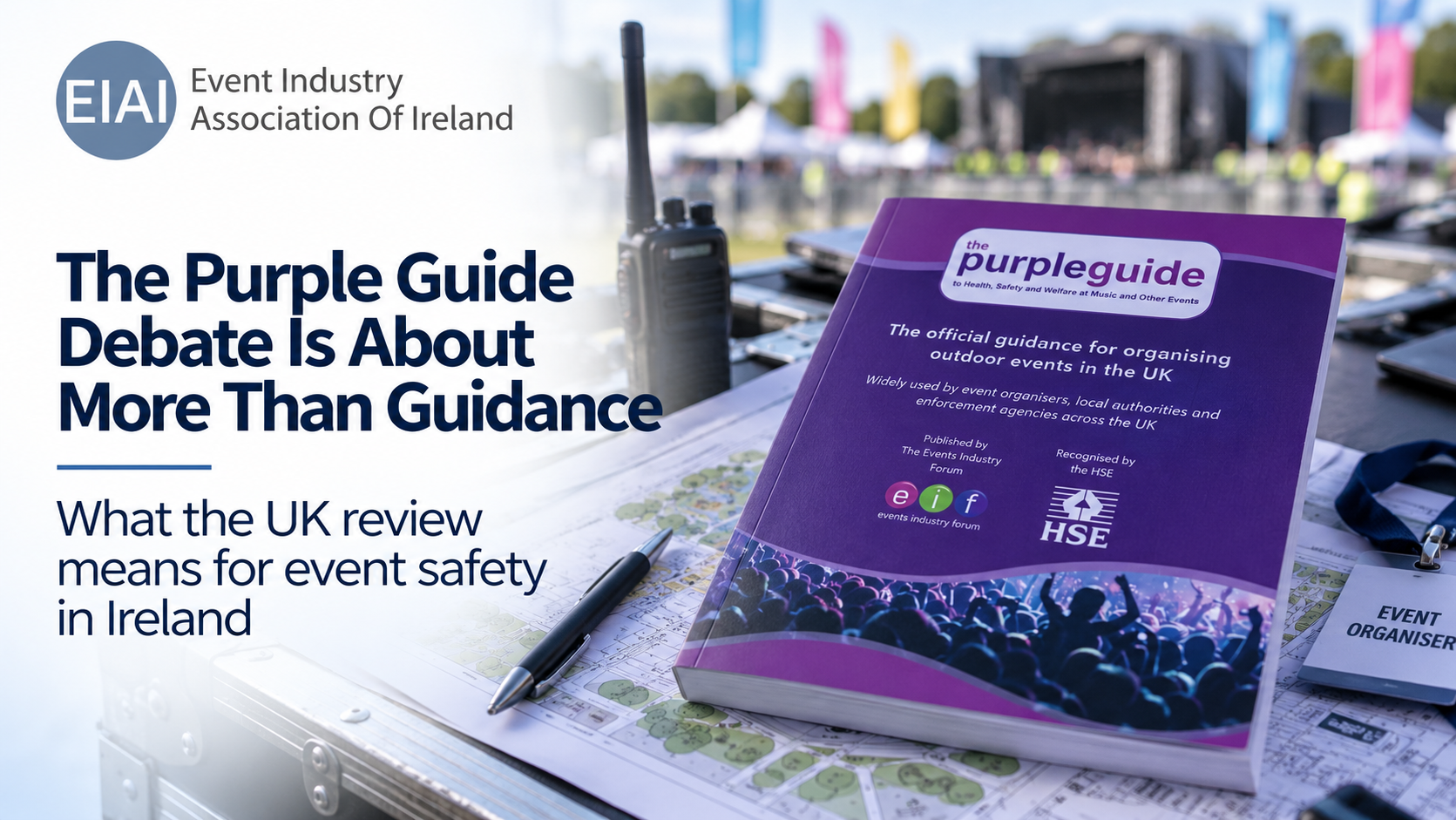
A major UK review of the way public events are planned has raised a question that deserves considerably more attention in Ireland: what happens when professional guidance becomes so embedded in an event-safety system that it begins to perform functions the law and regulatory framework have never formally assigned to it?
In September 2026, His Majesty’s Inspectorate of Constabulary and Fire & Rescue Services (HMICFRS) published its inspection of the police role in Safety Advisory Groups and the planning of major public events in England and Wales. Its conclusions extend well beyond policing, identifying inconsistencies in how Safety Advisory Groups operate, insufficient clarity around the responsibilities of different organisations, gaps in training and national risk assessment, and the absence of a general safety-certification regime for most public events comparable with that applying to designated sports grounds.
The HMICFRS official news release, “Inspectorate calls for government review of public safety at events”, published on 4 September 2026, sets out the Inspectorate’s principal findings and formal call for government action. Read the HMICFRS official news release on WiredGov HMICFRS made 37 recommendations, culminating in a call for a wider government review of public-safety arrangements at events. One finding has attracted particular attention within the event industry because the Inspectorate concluded that the Purple Guide, widely relied upon in event planning, overstates the legal responsibility of event organisers while understating the roles of the police and other emergency services. It also drew attention to a more fundamental point, namely that the Purple Guide is professional guidance rather than law.
Read narrowly, that finding might sound like criticism of the Purple Guide or an argument that organisers carry less responsibility than previously understood, but that interpretation would miss the more important issue. The real question is not whether the Purple Guide is useful or whether organisers hold substantial safety responsibilities. The question is whether professional guidance has gradually been required to carry responsibilities that should properly have been resolved within the underlying governance framework.
The issue is not whether the Purple Guide is good guidance
The Purple Guide is one of the most significant event-safety resources available internationally, bringing together specialist knowledge across event management, crowd safety, medical provision, temporary structures, transport, fire safety, welfare and many other operational areas. Guidance of this kind is essential because legislation cannot contain the technical detail required to plan every event, and professional guidance has an important role in translating legal duties, specialist knowledge and accumulated experience into practical standards that organisers and practitioners can use.
The difficulty begins when guidance is no longer simply explaining how a clearly established responsibility should be discharged, but is increasingly expected to answer the more fundamental question of who holds that responsibility in the first place. Those are two different functions, the first sits properly within professional guidance, while the second is a matter of governance, statutory responsibility and institutional design.
The UK review exposes a responsibility problem
Temporary public events operate across organisational boundaries, which means that responsibility is rarely held by a single actor. An organiser may control the event site, contractors and many aspects of crowd management, while a venue or landowner may retain separate responsibilities. Local authorities may exercise licensing, planning, roads, environmental or landowner functions, while police retain particular statutory powers and fire and ambulance services have their own responsibilities. Transport authorities and operators may control critical parts of the surrounding environment, and security providers, medical providers and specialist contractors may also exercise significant safety-critical functions.
These interfaces become especially important when routine event operations begin to move towards an emergency. The relevant question is therefore not whether organisers have substantial responsibilities, because they plainly do, but whether everyone involved can identify before an event takes place where one organisation’s responsibility begins and ends, where responsibilities overlap, who has authority to make particular decisions, and how operational control changes as an incident escalates.
The HMICFRS findings suggest that these boundaries are not consistently clear within the UK system. Safety Advisory Groups themselves are non-statutory, their operation varies considerably between areas, and most temporary public events do not sit within a general safety-certification regime equivalent to that applying to designated sports grounds. This takes the issue well beyond a debate about a guidance document and into the much wider question of how event safety is governed.
When guidance substitutes for statutory clarity
There is an institutional risk here that deserves to be stated clearly. When guidance begins to substitute for statutory clarity, responsibility becomes implicit rather than explicit, creating precisely the circumstances in which failures may later be examined through inquiries, litigation or post-incident reviews rather than having been resolved properly during the planning stage.
The concern arising from the UK inspection is that some fundamental questions about responsibility can ultimately be examined retrospectively, after an incident has occurred, rather than being sufficiently settled as part of the event-planning framework beforehand. Ireland has an opportunity to resolve these questions now, deliberately and coherently, rather than through the aftermath of an incident.
Ireland has no single national event-safety framework
Ireland already has extensive legislation and regulation relevant to events, including workplace-safety law, fire-safety requirements, planning law, licensing systems, private-security regulation, road legislation, local-authority procedures, Codes of Practice and professional guidance. What Ireland does not currently have is one coherent national event-safety framework spanning temporary public events across event type, scale, venue and risk.
For qualifying outdoor events, the Planning and Development framework provides a formal licensing process involving event management plans, safety arrangements, emergency planning, traffic management and designated senior roles. For indoor events, the Oireachtas enacted the Licensing of Indoor Events Act in 2003, including provisions relating to licensing, safety, inspection and Codes of Practice, yet the substantive indoor-event licensing provisions remain uncommenced. At the same time, Ireland’s principal national guidance on outdoor musical events dates from 1996 and remains in circulation three decades later.
This does not mean that Irish events operate without regulation. Rather, it means that the regulatory picture is fragmented, requiring organisers, consultants and public authorities to assemble applicable requirements from different pieces of legislation, legacy Codes, local procedures, professional standards and external guidance. That is a functioning regulatory environment, but it is not the same thing as a coherent national event-safety framework.
Regulatory drift: when guidance becomes the system
One useful way of describing what can happen in that type of environment is regulatory drift. The process usually develops gradually rather than through any deliberate policy decision. Guidance becomes established practice, established practice becomes expectation, and expectation becomes the standard against which plans are assessed. Over time, that standard can begin to operate as quasi-regulation until, eventually, it becomes part of the practical system despite never having gone through the legislative, regulatory or policy process that would ordinarily determine its authority, scope and accountability.
This distinction matters because different requirements carry different legal status. Legislation has a defined statutory basis, while a licence condition derives authority from a particular legal process. Government guidance, local-authority guidance, technical standards and professional industry guidance each sit differently within the overall framework. Where those categories become blurred, organisers may reasonably struggle to determine whether a particular requirement is mandatory, advisory, negotiable, risk-dependent or simply well-established practice.
Public officials can face the same difficulty. In the absence of modern national guidance, respected external standards understandably become an important source of assurance, particularly where they address specialist areas that existing Irish material does not cover in sufficient detail. The difficulty is that, over time, the external standard can begin to fill a governance gap that was never formally assigned to it.
That drift is already visible in Ireland
The Purple Guide is already widely used within Irish event planning, and there is nothing inherently problematic about that. Where Irish guidance does not address a specialist issue adequately, good international guidance can be extremely valuable and can improve the quality and consistency of event planning.
The concern arises when an external professional standard begins to carry quasi-regulatory weight because the national system has not supplied a sufficiently clear alternative. Purple Guide principles are routinely used by event professionals and consultants as benchmarks for planning and safety provision, while public bodies have also incorporated the Guide into Irish event-safety material. Where those expectations then become reflected in planning discussions, licence processes or stakeholder requirements, the distinction between recognised good practice and a mandatory requirement can become increasingly difficult to identify.
The question is therefore not whether the Purple Guide should be used in Ireland, because it should remain an important professional resource. The more important question is whether Ireland has consciously determined which standards apply, why they apply, who has authority to require them and how they interact with Irish law. If those questions are not clear, regulatory drift begins to replace regulatory design.
Competence also needs a national framework
The UK review raises a related issue around competence. Irish regulation already recognises that safety-critical roles may require defined competence, with construction regulation providing an obvious example. Event guidance also expects suitably competent Event Controllers and Event Safety Officers, yet Ireland does not have a single national competence framework for the people carrying out senior safety-coordination roles across temporary public events.
There is currently no consistent national answer to questions such as what competence an Event Controller or Event Safety Officer should demonstrate, how those requirements should change as event complexity increases, how professional experience should be assessed, which formal qualifications may be relevant, or how competence should be demonstrated to an organiser or licensing authority.
A workable national system should not equate competence with possession of one particular certificate. Instead, it should establish clear national standards while operating proportionately according to event risk and complexity, and it should recognise both relevant formal qualifications and demonstrable professional experience. The objective should be assurance rather than credentialism, because a small community event and a major temporary festival plainly do not require identical management structures, even though both require confidence that those making safety-critical decisions possess competence appropriate to the responsibilities they carry.
Attendance thresholds are not a risk model
The same principle should apply to the way events themselves are categorised. Attendance thresholds provide clear regulatory triggers and remain an important part of event regulation, but attendance alone is not an adequate measure of risk. A smaller event may involve complex temporary structures, difficult emergency access, water hazards, alcohol, high-density standing crowds, pyrotechnics, extensive temporary electrical systems or challenging transport arrangements, while a much larger event taking place within an established venue may benefit from permanent infrastructure, mature operating procedures and experienced management systems.
The more meaningful distinction is therefore not simply between large and small events, but between different levels of complexity and risk. Ireland should consider a tiered national event-risk model in which the required level of planning, competence, assurance and multi-agency involvement increases according to defined risk factors. Attendance would remain relevant, but it would sit alongside considerations such as venue type, audience profile, temporary infrastructure, crowd density, event duration, alcohol, water proximity, transport complexity, fire risk, temporary power, weather exposure, security considerations and emergency-access constraints. Such a model would support more proportionate regulation while ensuring that technically complex events do not fall below meaningful scrutiny simply because their attendance happens to sit below a prescribed threshold.
Temporary events require a different regulatory logic
The UK comparison with sports grounds is particularly instructive because permanent sports venues operate within relatively stable environments. Their capacities, exits, structures, access routes and operating arrangements can be inspected and reassessed repeatedly, whereas temporary events often create an operational environment almost from scratch. Structures may be installed and removed within days, electrical and power systems are temporary, vehicle and pedestrian routes change, multiple contractors work simultaneously, weather can materially alter site conditions, and Event Control itself may be created specifically for the event. Thousands of people may therefore enter a site that had no equivalent operational use a week earlier. Temporary events consequently require a regulatory logic designed specifically for temporary environments. That does not mean applying less scrutiny, but rather applying the right level and type of scrutiny to the risks actually being created.
Responsibility Mapping
One of the most practical reforms would be the development of a national responsibility map for public events, designed not to transfer responsibility away from organisers, venues or public authorities, but to make responsibilities, boundaries and decision-making authority visible before an event takes place. The map should address the principal roles and interfaces involving the event organiser, venue operator, landowner, Event Controller, Event Safety Officer, local authority, An Garda Síochána, fire authority, National Ambulance Service, contracted event medical providers and other relevant health or emergency medical services, transport authorities and operators, traffic-management providers, licensed private security providers and crowd-management providers, alongside any other statutory or operational bodies whose functions are relevant to the event.
The particular value of such a map would lie in clarifying the interfaces between those actors. It should help establish who controls safety within the event footprint, what responsibilities remain with the venue or landowner, who controls public roads and transport infrastructure, who has authority to require changes to an event plan, how overlapping statutory responsibilities are managed, when an incident is considered to have moved beyond routine event management, who has authority to escalate, and how operational control is transferred or shared with emergency services. These questions should not be left to assumption, particularly because the points at which responsibilities overlap are often where the greatest operational uncertainty exists.
What the responsibility map should produce
A national responsibility-mapping system should produce practical and identifiable outputs rather than simply another general statement of principle. At national level, it should result in a responsibility matrix setting out the principal functions, powers, duties and interfaces of organisations involved in event planning and response. That matrix should then support event-type-specific responsibility templates, recognising that the arrangements relevant to a city-centre parade, a music festival, a stadium concert, an agricultural show or a community event will not always be identical. It should also support emergency-escalation authority charts showing how decision-making changes as an incident progresses from routine event management into enhanced response and, where necessary, emergency-service command arrangements.
At individual event level, organisers should be required to document responsibility boundaries within the Event Management Plan or equivalent safety documentation, including areas where responsibility is shared or intersects with another organisation. Importantly, this should not operate as a one-sided declaration by the organiser. Where public authorities or statutory agencies have identified roles within an event arrangement, there should be a mechanism through which those roles are formally acknowledged, so that organisers are not expected to construct multi-agency response arrangements based on assumptions about what another organisation may do during an emergency.
Risk, responsibility and competence must connect
Responsibility mapping should also connect directly to event risk and complexity. Lower-risk events may require relatively straightforward responsibility arrangements, while more complex events should require more detailed mapping, clearer multi-agency interfaces, formal Event Control arrangements, defined escalation structures and more explicit command-transfer provisions. Competence requirements should develop alongside the level of responsibility being exercised, because a person carrying a limited operational responsibility at a relatively straightforward event should not necessarily be subject to the same competence requirements as someone coordinating safety across a high-risk temporary event involving substantial infrastructure and multiple public agencies. Emergency authority should follow the same logic, with higher-risk events requiring clearer escalation triggers and more formal multi-agency command arrangements. In this way, risk, responsibility and competence would operate as connected parts of the same national framework rather than as separate policy initiatives.
The responsibility map needs recognised authority
There is an obvious danger in proposing a responsibility map within a paper that is itself warning about over-reliance on non-statutory guidance. If the map were simply published as another advisory document, Ireland could reproduce the very problem it is trying to solve. The responsibility framework therefore needs recognised authority within the event-governance system, whether through statutory recognition, regulatory recognition or incorporation into event-licensing requirements and licence conditions. The precise legal mechanism would require further policy consideration, but the principle should be clear: if responsibility is important enough to define nationally, the status of that framework must also be clear nationally.
National Guidance Architecture
Responsibility mapping should sit alongside a National Guidance Architecture for Event Safety, because Ireland does not simply need another updated document. It needs a coherent system for organising, maintaining and understanding event-safety guidance. At the centre should be a modern Irish national event-safety code written specifically for the Irish legal, regulatory and operational environment. That core code should establish national principles around governance, responsibility, competence, planning, risk assessment, assurance, Event Control and multi-agency working.
Around that core should sit specialist modules capable of being updated independently as professional practice develops. These could address areas such as crowd planning and management, medical and welfare provision, temporary structures, fire safety, transport and traffic management, emergency planning, temporary electrical systems and power, weather, security, water safety, accessibility, communications, safeguarding and other specialist subjects as required. A modular approach is important because technical practice evolves more quickly than large national Codes or primary legislation can reasonably be revised. The central governance framework should therefore remain relatively stable, while specialist material can be updated more frequently to reflect emerging risks, technical developments and professional learning.
Most importantly, the entire architecture should be explicitly aligned with Irish law and should identify the status of individual requirements. An organiser should be able to distinguish clearly between a statutory requirement, a licence condition, Government or agency guidance, a technical standard and professional good practice. This would allow resources such as the Purple Guide to continue contributing valuable specialist knowledge without requiring organisers or public officials to determine for themselves how individual UK provisions translate into the Irish system. The objective is not to separate Ireland from international best practice, but to place international best practice within a coherent Irish framework.
A modern digital guidance architecture could also support risk-based planning more effectively than a single static publication by allowing organisers and public authorities to identify the requirements relevant to a particular type of event, understand their status and trace the relationship between legislation, licence requirements, national guidance and professional standards.
A National Event-Safety Governance Framework
Taken together, these reforms point towards a wider National Event-Safety Governance Framework built around four connected elements. The first is responsibility, through a nationally recognised responsibility map establishing roles, powers, duties and organisational interfaces, including emergency escalation and the transfer of operational authority. The second is competence, through a tiered national framework for safety-critical event roles, particularly Event Controllers and Event Safety Officers, which links competence requirements to event risk and the level of responsibility being exercised.
The third element is guidance, through a modern national event-safety code supported by specialist modules and clearly distinguishing legal requirements, licence conditions, official guidance, technical standards and professional good practice. The fourth is multi-agency operations, through a consistent national model for planning, Event Control, information exchange, escalation, emergency handover and post-event review that remains proportionate to the risk and complexity of the event. Local adaptation would still be necessary because national consistency does not mean that every event should be managed identically. It means that every organiser, public body and professional begins from the same understanding of how the overall system works.
Ireland can act before a review is forced upon us
These concerns are not new, and EIAI has already raised the age of Ireland’s principal event Codes, inconsistencies in guidance and the need for a more coherent national approach to the event industry. The HMICFRS findings now give that discussion an important international context because they demonstrate how professional expertise and extensive guidance can keep a system functioning for years while structural weaknesses remain unresolved underneath it. Those weaknesses tend to become most visible when there is disagreement, when an event falls between established processes, when an incident crosses organisational boundaries, or when responsibility is examined after something has already gone wrong.
Recommendation 37 of the UK inspection calls for a ministerially led, cross-departmental review of public safety at events. Ireland should watch that process closely, but we do not need to wait for the UK to complete its review before considering the same structural questions here. Indeed, there is a clear advantage in acting now. Ireland can learn from the problems identified in the UK without automatically inheriting whatever solution is eventually chosen there, allowing us to examine our own legislation, public-authority structures and event environment and develop a framework suited to Irish conditions before a major incident forces the issue.
Updating the 1996 Code is necessary, but it is not enough
Ireland clearly needs contemporary national event-safety guidance because an event environment transformed by modern crowd science, temporary infrastructure, accessibility requirements, CCTV, digital communications, hostile-vehicle mitigation, extreme-weather planning, safeguarding, specialist medical provision and increasingly sophisticated multi-agency Event Control cannot reasonably continue to depend on guidance developed three decades ago. Updating the 1996 Code is therefore necessary, but the UK experience demonstrates why it cannot be the whole answer. If Ireland produces a new Code while continuing to rely on that document to allocate responsibilities that have never been clearly resolved in policy or law, we will simply have newer guidance sitting on top of the same structural problem.
Before guidance explains how a responsibility should be discharged, the national system should explain whose responsibility it is. Before guidance describes good practice for an Event Safety Officer, there should be a national understanding of the competence required to perform that function. Before an organiser is expected to meet an external benchmark, it should be clear whether that benchmark is a statutory requirement, a licence condition, official guidance or professional good practice. Those distinctions are not bureaucracy, they are an essential part of safety governance.
The real lesson from the Purple Guide debate
The lesson from the UK is not that the Purple Guide has failed. In many respects, its importance demonstrates the opposite, because the event industry needed practical, specialist and evolving guidance and the Purple Guide helped provide it. The problem is what can happen around successful guidance when the underlying governance structure remains incomplete. Guidance becomes practice, practice becomes expectation, expectation becomes quasi-regulation and, eventually, guidance begins carrying responsibilities that should have been resolved by the system itself.
Ireland should not stop using good international guidance, but we should stop requiring guidance to compensate for the absence of a coherent national event-safety framework. The question we should be able to answer before an event opens its gates is whether everyone involved can identify who is responsible for what, what competence is required, how the level of oversight reflects the actual risk, how agencies work together, when authority changes during an emergency and which requirements are legally binding rather than simply recognised good practice.
If the answer depends on the county, the individual official, the consultant involved or whichever external guidance happens to be used, the system is not sufficiently clear. Ireland now has an opportunity to build a coherent framework in which risk determines the level of scrutiny, responsibility determines who must act, competence determines who is capable of carrying that responsibility, and the guidance architecture explains how those duties should be discharged.
Such a framework would not reduce responsibility. It would make responsibility explicit, proportionate and capable of being understood before something goes wrong, while giving organisers, statutory agencies and event professionals a common national structure within which to work. Ireland has the opportunity to resolve these questions now, deliberately and coherently, rather than through the aftermath of an incident. That is the central lesson from the UK review and the opportunity now available to us: to design the framework before failure exposes the gaps, rather than redesigning it afterwards.