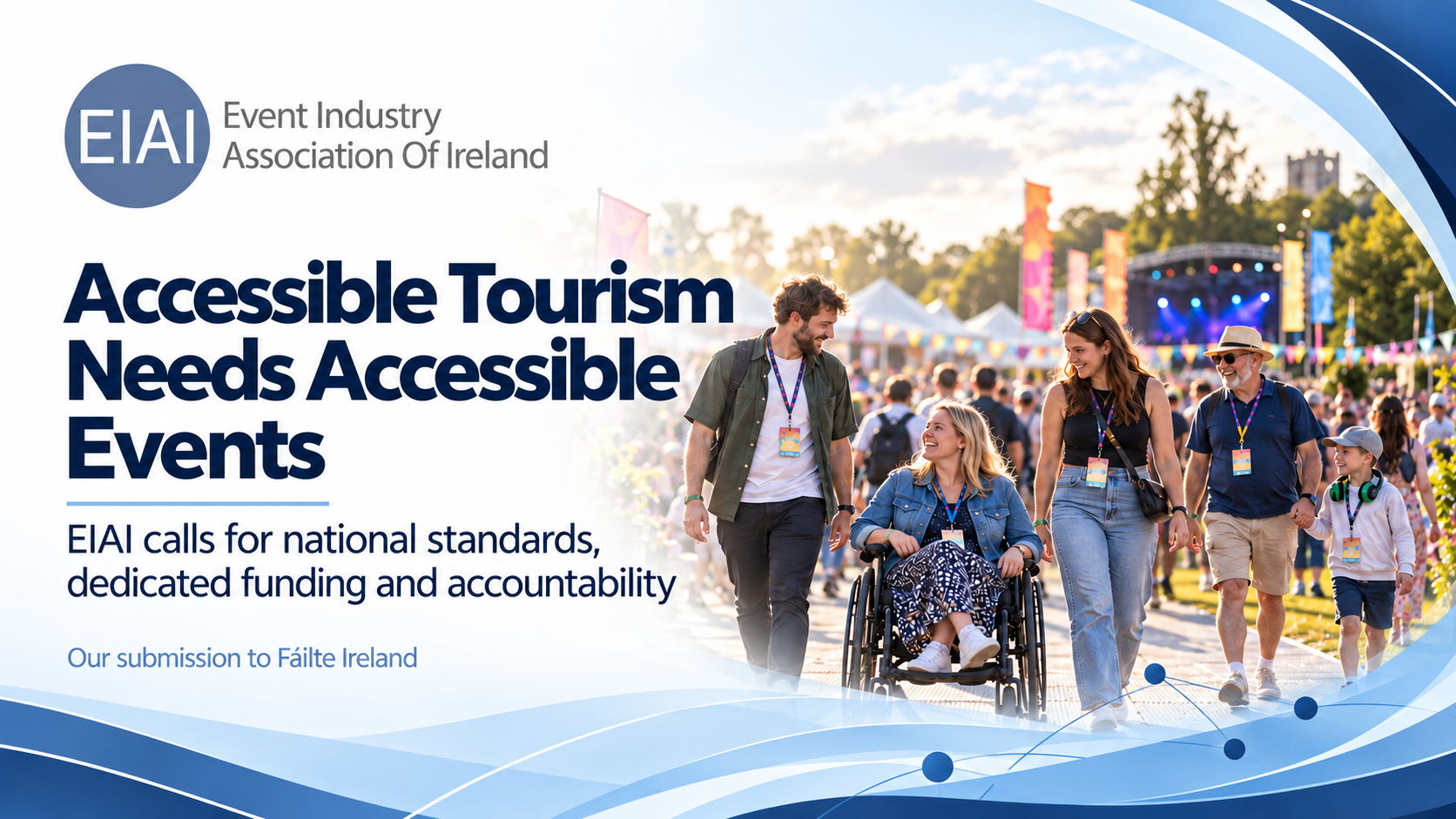
National standards, dedicated funding and checks on delivery are needed to ensure everyone can attend, participate in and enjoy Ireland’s events. An accessible event viewing area is only useful if someone can reach it. A welcoming event must also offer a workable journey home. And disabled people should have opportunities to perform, compete, speak, volunteer and work at events, as well as attend them.
These are central messages in the Event Industry Association of Ireland’s submission to Fáilte Ireland’s Your Voice, Your Journey consultation on Accessible and Inclusive Tourism. EIAI is calling for festivals, parades, conferences, sporting and community events to be explicitly included in the resulting national programme, with practical support for organisers and clear accountability for delivery.
Events are part of the tourism experience
Events give people reasons to travel, stay overnight and explore a destination. They support accommodation providers, restaurants, transport operators and local businesses, while connecting visitors with Ireland’s culture and communities. Their accessibility depends on a connected set of arrangements. Information, booking, transport, public spaces, temporary infrastructure and customer service all influence whether someone can participate.
For organisers, delivering this consistently requires clear expectations, competent guidance and resources. Temporary sites, seasonal teams and volunteer-led delivery create practical challenges that national policy must address.
Three priorities for change
EIAI’s submission identifies three priorities:
- A National Accessible Events Standard and practical guidance. Build on existing resources to establish consistent expectations for different event formats, sizes and locations.
- An Accessible Events Fund. Support infrastructure, specialist services, access planning, communication, training and other practical improvements.
- Consistent implementation and accountability. Embed proportionate accessibility plans in relevant funding, licensing and approval processes, with checks that promised arrangements are delivered.
Visitors should be able to expect reliable accessibility across Ireland. Their experience should not depend on which county hosts an event. A national approach should also recognise the circumstances of smaller and rural events, where transport, equipment availability, surfaces, lighting and limited infrastructure can present particular challenges.
The journey home matters
Accessibility planning often concentrates on arrival. EIAI’s submission gives equal attention to what happens when an event ends. Crowding, fatigue, reduced transport services and inaccessible diversions can make departure more difficult than arrival. An accessible drop-off point offers little reassurance if there is no suitable collection point or transport available after the event.
EIAI is calling for organisers, local authorities and transport providers to coordinate departure arrangements, maintain accessible routes during dispersal and communicate the options before visitors travel. The same practical approach must apply throughout the event. Routes should be assessed under actual operating conditions, including crowds, temporary barriers, rain and darkness.
Participation must be part of inclusion
Disabled people should have meaningful opportunities to take part in Ireland’s cultural, sporting and business life. That means considering access to rehearsal spaces, costume fittings, parade assembly areas, stages, backstage facilities, sporting start lines and volunteer briefings. For conferences and business events, organisers should ask about access requirements at registration and confirm arrangements before travel. Speaker areas, exhibition spaces, networking activities and presentation materials all need to support participation.
Accessible events also strengthen disabled children’s and young people’s inclusion in community life. Planning should recognise that access needs can overlap, including mobility, sensory, cognitive and fatigue-related requirements.
Funded activity should be audited
EIAI is calling for Fáilte Ireland-funded activity to be subject to proportionate accessibility and inclusion audits. Plans and training records are useful, but they cannot establish on their own whether an event is accessible. Evaluation should examine what was delivered and how people experienced it, including whether they could participate with dignity, independence and confidence.
Audits should draw on feedback from disabled attendees and participants. Where arrangements fall short, corrective action should have a responsible owner and a clear timescale. Pilot findings and accessible summaries of delivery checks should be shared transparently, showing what has improved, where barriers remain and what will happen next. Accountability must be supported by funding and competent advice. Organisers need the means to deliver improvements, alongside clear expectations about the outcomes required.
Turning consultation into action
EIAI’s submission brings the operational perspective of the events sector to the consultation. That perspective must sit alongside the direct involvement of disabled people and their representative organisations in shaping and evaluating the national response. EIAI has requested inclusion in the planned follow-up focus groups and welcomes further engagement with Fáilte Ireland on the proposals.
The consultation is an opportunity to establish a funded programme with named responsibilities, clear milestones and measurable outcomes. Its success should be judged by whether people can plan, book, arrive, participate and return with confidence. Accessible events must become a consistent expectation of Ireland’s tourism offering. Every person should have a fair opportunity to experience them with dignity and equal opportunity.
Read the full submission here: EIAI Accessible and Inclusive Tourism Submission